EN
EN English
 中文简体
中文简体 русский
 Deutsch
 日本語
日本語 한국어
한국어

The NdFeB magnet composition is a precisely engineered metallurgical formula based on the intermetallic compound neodymium-iron-boron (Nd₂Fe₁₄B), which forms the hard magnetic phase that gives these magnets their extraordinary strength. In a typical commercial sintered neodymium magnet, neodymium accounts for approximately 29% to 32% by weight, iron makes up 64% to 68%, and boron constitutes about 1.0% to 1.2%, with the remaining fraction consisting of additive elements such as dysprosium, terbium, praseodymium, cobalt, copper, aluminum, and niobium that are introduced to enhance coercivity, thermal stability, and corrosion resistance. According to the Journal of Magnetism and Magnetic Materials, the discovery of the Nd₂Fe₁₄B phase in 1984 by Masato Sagawa and John Croat revolutionized permanent magnet technology by creating a magnet with a maximum energy product exceeding 50 megagauss-oersteds (MGOe), roughly ten times that of the ferrite magnets it replaced. Understanding the exact NdFeB magnet composition and the function of each constituent element is essential for engineers selecting the correct magnet grade for high-temperature motors, wind turbine generators, medical imaging devices, and consumer electronics.
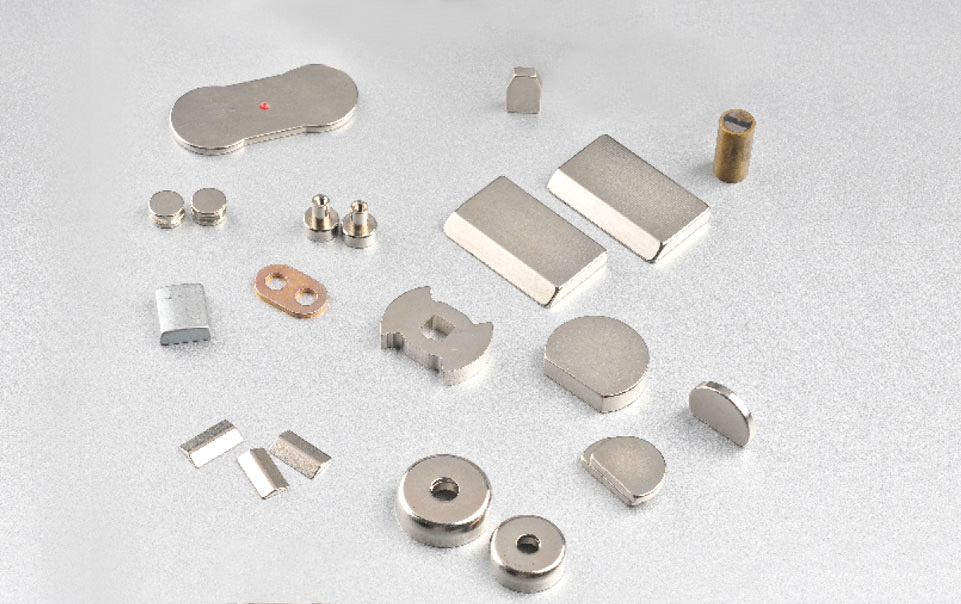
Explore Key Applications of Magnetic Materials
1. What Is the Basic NdFeB Magnet Composition?
The fundamental NdFeB magnet composition is the intermetallic compound Nd₂Fe₁₄B, which constitutes approximately 85% to 95% of the magnet's volume and provides the hard magnetic phase responsible for generating the intense magnetic field. The atomic structure of Nd₂Fe₁₄B is a tetragonal crystal system with a complex unit cell containing 68 atoms: 8 neodymium atoms, 56 iron atoms, and 4 boron atoms. The neodymium atoms occupy specific lattice sites where their unpaired 4f electrons create the immense magnetocrystalline anisotropy that gives NdFeB its high coercivity. The iron atoms, occupying six crystallographically distinct sites, provide the high saturation magnetization through their aligned 3d electron spins. The boron atoms, though small in number, are structurally critical because they stabilize the tetragonal phase and prevent the formation of other, magnetically inferior iron-neodymium phases. Without boron, the alloy would crystallize into a mixture of soft magnetic phases that could not hold a permanent magnetic charge. In a typical commercial NdFeB magnet composition, the overall elemental weight percentages are approximately 29-32% neodymium, 64-68% iron, and 1.0-1.2% boron. However, the as-cast alloy before sintering is intentionally formulated to be slightly richer in neodymium than the stoichiometric 2:14:1 ratio. This excess neodymium forms a neodymium-rich grain boundary phase that is essential for the liquid-phase sintering process and for magnetically decoupling the Nd₂Fe₁₄B grains from one another, which dramatically increases coercivity. The neodymium-rich phase typically constitutes 5% to 15% of the total volume and can contain dissolved oxygen, carbon, and small amounts of transition metals.
2. The Role of Each Element in the NdFeB Magnet Composition
Every element in the NdFeB magnet composition serves a specific structural or magnetic function, and altering the balance of these elements—even by fractions of a percent—can dramatically change the magnet's coercivity, remanence, temperature stability, and corrosion resistance. The detailed roles of the core and additive elements are as follows:
- Neodymium (Nd): Neodymium is the primary rare earth element that provides the immense magnetocrystalline anisotropy. Its 4f electron orbital is highly directional, creating an easy axis of magnetization along the c-axis of the tetragonal crystal. This anisotropy field reaches approximately 7.3 tesla, which is the underlying reason why NdFeB magnets can achieve such high coercivity. In practice, commercial magnets often use a mixture of neodymium and praseodymium in the naturally occurring didymium ratio because the two elements are chemically similar and separating them adds cost without proportional magnetic benefit for many applications.
- Iron (Fe): Iron provides the high saturation magnetization. Its 3d electron spins align ferromagnetically and contribute roughly 2.2 Bohr magnetons per atom to the total magnetic moment. The remanence of an NdFeB magnet is directly proportional to the volume fraction of the Nd₂Fe₁₄B phase and the alignment of the iron spin moments. Partially substituting cobalt for iron, typically at 5% to 15% of the iron content, increases the Curie temperature and improves thermal stability, though it slightly reduces the room-temperature saturation magnetization.
- Boron (B): Boron is the essential metalloid that stabilizes the tetragonal crystal structure. Its small atomic radius allows it to fit into interstitial sites within the iron-neodymium framework, where it forms directional covalent bonds that lock the atoms into the correct configuration. Without boron, the alloy would decompose into the binary phases Nd₂Fe₁₇ and NdFe₂, neither of which possesses the required magnetocrystalline anisotropy.
- Dysprosium (Dy) and Terbium (Tb): These heavy rare earth elements are the most critical additives in the NdFeB magnet composition for high-temperature applications. Dysprosium substitutes for neodymium in the Nd₂Fe₁₄B lattice, increasing the anisotropy field and thus the coercivity, which allows the magnet to resist demagnetization at elevated temperatures. A magnet with 4% to 8% dysprosium by weight can maintain useful coercivity at 150°C to 200°C, compared to a maximum of about 80°C for a dysprosium-free magnet. Terbium is even more effective than dysprosium but is rarer and more expensive.
- Cobalt (Co): Cobalt raises the Curie temperature of the Nd₂Fe₁₄B phase by approximately 10°C per atomic percent of substitution for iron. A magnet with 5% cobalt may have a Curie temperature of 350°C to 370°C compared to 310°C to 320°C for a cobalt-free composition. Cobalt also improves corrosion resistance by reducing the electrochemical potential difference between the Nd₂Fe₁₄B grains and the neodymium-rich grain boundary phase.
- Copper (Cu), Aluminum (Al), and Niobium (Nb): These minor additives, typically present at 0.1% to 1.0% each, refine the microstructure during sintering and improve the wetting behavior of the liquid grain boundary phase. Niobium forms small precipitates that pin grain boundaries and prevent excessive grain growth during the high-temperature sintering cycle, which is essential for maintaining a fine grain size and high coercivity.
3. How Composition Determines the Three Key Magnetic Properties
The NdFeB magnet composition directly governs the three cardinal magnetic parameters—remanence, coercivity, and maximum energy product—and each adjustment to the element balance shifts the magnet along a spectrum of performance trade-offs. The remanence (Br) of a fully dense, perfectly aligned NdFeB magnet is fundamentally limited by the saturation magnetization of the Nd₂Fe₁₄B phase, which is approximately 1.6 tesla. In practice, commercial sintered magnets achieve remanence values of 1.0 to 1.5 tesla, depending on the volume fraction of the magnetic phase and the degree of crystallographic alignment achieved during the pressing stage. The intrinsic coercivity (Hci) is controlled by the magnetocrystalline anisotropy field of the Nd₂Fe₁₄B grains and by the effectiveness of the grain boundary phase in magnetically isolating each grain. Pure Nd₂Fe₁₄B has an anisotropy field of about 7.3 tesla, but the practical coercivity is only a fraction of this value—typically 10 to 30 kilo-oersteds (kOe)—because reversed magnetic domains nucleate at grain boundaries and crystal defects at much lower fields than the theoretical limit. Adding dysprosium increases the anisotropy field and therefore the coercivity, but dysprosium couples antiferromagnetically with iron, which reduces the saturation magnetization and the remanence. This is the central design trade-off in NdFeB magnet composition: more heavy rare earth content buys higher coercivity and better elevated-temperature performance at the cost of lower room-temperature remanence and maximum energy product. The maximum energy product (BHmax), measured in MGOe, represents the maximum amount of magnetic energy that can be stored in a unit volume of the magnet. The theoretical maximum for Nd₂Fe₁₄B is approximately 64 MGOe. Commercial N52 grade magnets achieve about 50 to 53 MGOe, while high-temperature grades with heavy rare earth additions typically range from 30 to 45 MGOe.
4. Sintered vs. Bonded NdFeB: How Composition and Processing Differ
The NdFeB magnet composition is processed into magnets through two fundamentally different manufacturing routes—sintering and bonding—which produce magnets with vastly different densities, magnetic properties, and application suitability. The table below summarizes the key differences between sintered and bonded NdFeB magnets.
| Characteristic | Sintered NdFeB | Bonded NdFeB |
|---|---|---|
| Manufacturing Process | Powder pressed in magnetic field, then sintered at 1,000–1,150°C | Powder mixed with polymer or epoxy binder, then compression or injection molded |
| Density | 98–100% of theoretical (7.5–7.6 g/cm³) | 60–80% of theoretical (4.5–6.0 g/cm³) |
| Maximum Energy Product | 30–53 MGOe | 5–12 MGOe |
| Shape Complexity | Limited; requires diamond grinding for tight tolerances | High; can be molded into intricate near-net shapes |
| Typical Applications | EV traction motors, wind turbine generators, MRI scanners, high-end speakers | Sensors, small DC motors, office automation, consumer electronics |
5. Heavy Rare Earth Elements and Grain Boundary Diffusion Technology
Heavy rare earth elements—dysprosium and terbium—are added to the NdFeB magnet composition to increase coercivity at high temperatures, but modern grain boundary diffusion technology now achieves this enhancement with far less material by concentrating these expensive elements only at the grain surfaces where they are most effective. In a conventional NdFeB magnet composition, dysprosium is mixed uniformly throughout the alloy powder before sintering. Because dysprosium substitutes for neodymium in the entire volume of each Nd₂Fe₁₄B grain, a significant fraction of the expensive heavy rare earth is effectively wasted in the grain interiors, where it reduces remanence without contributing proportionally to coercivity enhancement. Grain boundary diffusion, developed in the early 2000s and now widely deployed in commercial production, takes a different approach. A fully sintered magnet with a standard low-dysprosium or dysprosium-free composition is coated with a thin layer of dysprosium fluoride or terbium fluoride powder, then heat-treated at a temperature where the heavy rare earth diffuses along the grain boundaries into the interior of the magnet. The dysprosium atoms travel preferentially along the neodymium-rich grain boundary phase and substitute for neodymium only in a thin shell at the outer surface of each grain, typically 1 to 3 microns deep. Because reversed magnetic domains nucleate at the grain surfaces, this thin dysprosium-rich shell provides the same coercivity boost as a homogeneous addition while using 50% to 70% less dysprosium. A magnet produced by grain boundary diffusion can achieve a coercivity of 25 to 30 kOe with a total dysprosium content of less than 2% by weight, compared to the 6% to 8% required in a conventional homogeneous composition. This technology has been instrumental in reducing the cost and supply-chain vulnerability of NdFeB magnets for electric vehicle traction motors, where high-temperature coercivity is essential and dysprosium prices have historically been volatile.
6. NdFeB Magnet Grades and Their Composition Variations
The commercial grading system for NdFeB magnets—such as N35, N52, N35SH, and N48UH—encodes both the room-temperature energy product and the maximum operating temperature, and each grade family corresponds to a specific NdFeB magnet composition optimized for a particular thermal environment. The following list explains the common grade suffixes and their compositional implications:
- N-grade (no suffix): Standard composition with minimal or no heavy rare earth additions. Maximum operating temperature is typically 80°C. These grades, such as N35 through N52, offer the highest room-temperature energy product and are used in consumer electronics, computer hard drives, and magnetic fasteners.
- M-grade (medium coercivity): Slightly enhanced intrinsic coercivity through small dysprosium additions or optimized grain size. Maximum operating temperature is approximately 100°C. Used in moderate-temperature motor applications.
- H-grade (high coercivity): Contains a higher proportion of dysprosium in the NdFeB magnet composition. Maximum operating temperature is 120°C. Widely used in industrial servo motors and generators.
- SH-grade (super high coercivity): Further increased dysprosium content or grain boundary diffusion processing. Maximum operating temperature is 150°C. Specified for automotive traction motors and downhole oil exploration tools.
- UH-grade (ultra-high coercivity): Heavy dysprosium or terbium addition. Maximum operating temperature is 180°C. Used in high-speed electric vehicle motors and aerospace actuators.
- EH-grade (extremely high coercivity): The highest heavy rare earth content. Maximum operating temperature is 200°C. Reserved for specialized military and aerospace applications where demagnetization risk is extreme.
Frequently Asked Questions About NdFeB Magnet Composition
What is the exact chemical formula of the main phase in NdFeB magnets?
The primary magnetic phase in NdFeB magnets is Nd₂Fe₁₄B, a tetragonal crystal with a unit cell containing 68 atoms. In commercial magnets, some of the neodymium is typically replaced by praseodymium, and some iron is replaced by cobalt, so the actual phase composition is more accurately written as (Nd,Pr)₂(Fe,Co)₁₄B.
Why are NdFeB magnets so much stronger than ferrite magnets?
The NdFeB magnet composition produces a saturation magnetization of about 1.6 tesla and a magnetocrystalline anisotropy field of 7.3 tesla, while strontium ferrite magnets have a saturation magnetization of only about 0.47 tesla. This fundamental difference in the atomic magnetic moment and crystal field interaction means that NdFeB can store roughly ten times more magnetic energy per unit volume than ferrite.
Can NdFeB magnets be made without heavy rare earth elements?
Yes, heavy-rare-earth-free NdFeB magnets are commercially available and are increasingly used in applications where the maximum operating temperature does not exceed about 80°C to 100°C. These magnets rely on an extremely fine grain size, typically below 2 to 3 microns, and optimized grain boundary chemistry to achieve adequate coercivity without dysprosium or terbium.
Does the NdFeB composition include cobalt in all magnets?
No. Cobalt is an optional additive in the NdFeB magnet composition. It is used primarily in high-temperature grades to raise the Curie temperature and improve corrosion resistance. Standard N-grade magnets for room-temperature applications often contain little or no cobalt. The presence of cobalt is usually indicated in the manufacturer's datasheet.
The NdFeB magnet composition is a triumph of materials engineering, where the precise control of major elements and trace additives at the atomic level yields the strongest permanent magnets ever produced. From the fundamental Nd₂Fe₁₄B phase that provides the magnetic backbone, to the dysprosium-enriched grain boundaries that maintain coercivity at high temperature, each constituent plays an irreplaceable role in determining whether the final magnet will power an electric vehicle, stabilize a wind turbine generator, or simply hold a cabinet door closed.