EN
EN English
 中文简体
中文简体 русский
 Deutsch
 日本語
日本語 한국어
한국어

The selection of aerospace magnets is governed by an unyielding trade-off between thermal resilience and magnetic flux density. Samarium Cobalt (SmCo) dominates engine bay and deep-space applications where temperatures exceed 300 degrees Celsius, while Neodymium Iron Boron (NdFeB) is the preferred choice for weight-critical electric propulsion actuators operating below 150 degrees Celsius. This decision is not merely a material substitution but a fundamental design constraint affecting mission safety margins.
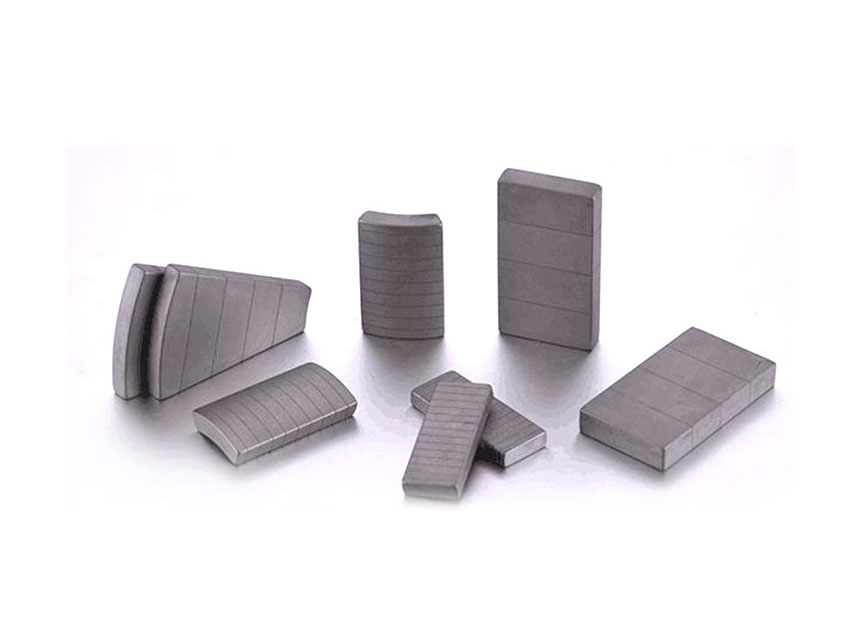
Explore Key Applications of Magnetic Materials
The Metallurgical Foundations of Aerospace Permanent Magnets
Unlike commercial magnets, aerospace magnets must maintain precise flux densities across extreme thermal gradients without irreversible microstructural decay. The two dominant families rely entirely on Rare Earth elements whose crystal lattice anisotropy defines the upper limit of coercivity achievable in a given volume. The phase composition of the magnetic material directly determines the service ceiling in high-vacuum and high-radiation environments.
Samarium Cobalt: The Ultra-High-Temperature Standard
Samarium Cobalt remains irreplaceable for aerospace magnets located near combustion chambers or planetary flyby thrusters. The Sm2Co17 grade exhibits a maximum energy product near 32 MGOe while maintaining structural integrity at 350 degrees Celsius. Its remanence temperature coefficient hovers around -0.035 percent per degree Celsius, a linearity that simplifies compensation algorithms in closed-loop control systems. Crucially, the inherent corrosion resistance of SmCo eliminates outgassing risks that plague coated materials in ultra-high-vacuum, making it the default choice for optical payload actuators on long-duration orbital platforms.
- Curie temperature: Typically 800 degrees Celsius to 850 degrees Celsius, providing a wide operational safety buffer.
- Compressive strength: Exceeds 800 MPa, enabling direct mounting in high-vibration engine frames.
- Radiation hardness: Minimal flux loss after total ionizing dose exposures exceeding 10 Mrad.
Neodymium Iron Boron: Maximizing Specific Power
Neodymium-based aerospace magnets currently push commercial maximum energy products to 56 MGOe, enabling electric propulsion motors with mass specific power beyond 7 kilowatts per kilogram. To survive the 180 degrees Celsius peaks encountered in high-power density windings, Heavy Rare Earth elements such as Dysprosium and Terbium are diffused into the grain boundary phase. This Grain Boundary Diffusion process raises the intrinsic coercivity above 30 kOe without sacrificing remanence, though the resulting magnet remains inherently susceptible to oxidation and requires multilayer nickel-copper-nickel coatings with strict adhesion testing per ASTM B571.
Satellite Reaction Wheels
SmCo magnets dominate reaction wheels in low Earth orbit constellations. Atomic oxygen erosion degrades protective coatings on NdFeB within months, while samarium oxide passivation layers maintain flux integrity for beyond 12-year design lives without generating conductive debris.
eVTOL Rotor Motors
NdFeB magnets enable the 200-kilowatt permanent magnet synchronous motors used in urban air mobility. A segmented Halbach array reduces eddy current losses by 40 percent while boosting torque density to 35 Nm per kilogram at 2500 RPM.
Quantitative Comparison of Aerospace Magnet Grades
Engineers quantifying aerospace magnets evaluate a matrix of remanence, coercivity, and thermal coefficients. The table below captures the critical divergences between standard aerospace specifications drawn from certified melters and validated through magnetic particle inspection-free batch certification.
| Parameter | Sm2Co17 (Aerospace Grade) | NdFeB (High Hci, Dy-diffused) | Design Significance |
|---|---|---|---|
| Remanence Br | 10.8 kG to 11.6 kG | 12.8 kG to 14.2 kG | Air gap flux density |
| Intrinsic Coercivity Hci | 25 kOe to 30 kOe | 30 kOe to 35 kOe | Overload demag resistance |
| Max Energy Product | 26 MGOe to 30 MGOe | 45 MGOe to 52 MGOe | Motor volume reduction |
| Max Continuous Temp | 350 degrees Celsius | 180 degrees Celsius to 220 degrees Celsius | Engine compartment suitability |
| Outgassing (TML) | Less than 0.1 percent | 0.5 percent (coated) | Optics contamination |
Comparison of critical magnetic and environmental parameters for aerospace-qualified permanent magnets. Values represent typical commercial offerings and may vary with proprietary doping profiles. Data sourced from publicly available aerospace material specifications and independent test reports.
Critical Design Limits and Failure Mechanisms
The operational envelope of aerospace magnets is defined not by room-temperature values but by the knee point of the B-H curve at the worst-case combination of temperature and demagnetizing field. Irreversible losses accumulate when the operating permeance line drops below this knee, a condition frequently triggered by short-circuit faults in motor windings or unanticipated thermal soakback after engine shutdown.
Thermal Demagnetization and Recovery
Reversible flux loss in aerospace magnets must remain below 5 percent across a mission profile spanning -180 degrees Celsius to 350 degrees Celsius. For deep space actuators, only certain SmCo alloys exhibit the required microstructural stability. Lab test data indicates that after 1000 thermal cycles between these extremes, Sm2Co17 experiences less than 2 percent irreversible loss, while even heavy-rare-earth-rich NdFeB can suffer up to 8 percent degradation unless actively cooled.
Mechanical Fracture and Retention Systems
Sintered aerospace magnets exhibit high compressive but low tensile strength, typically 750 MPa versus 35 MPa respectively. This anisotropy demands segmented architectures for rotor assemblies exceeding 20,000 RPM. Laser-cut magnet segments bonded with aerospace-grade epoxy and wrapped with carbon fiber sleeves reduce hoop stress concentrations by up to 60 percent compared to monolithic rings, preventing catastrophic fracture during high-g maneuvers.
Rare Earth Supply Chain Vulnerabilities
The strategic value of aerospace magnets is inextricably linked to the geographic concentration of rare earth processing. Over 85 percent of rare earth oxide separation and 90 percent of metal alloy production currently occurs in a single region. This bottleneck has led to the inclusion of permanent magnet materials in national defense stockpiles and the acceleration of magnet recycling technologies that recover neodymium from end-of-life hard disk drives and electric vehicle motors for re-melting into aerospace-grade ingots.
Heavy Rare Earth elements like Dysprosium, essential for high-temperature NdFeB coercivity, are particularly constrained. One metric ton of Dy-doped aerospace magnet can contain up to 8 kilograms of Dysprosium, a quantity requiring the mining of approximately 25 tons of ionic adsorption clay deposits. Alternatives such as cerium-based additions and dual-alloy sintering are being developed to reduce Dysprosium content by 30 percent without compromising the 30 kOe coercivity threshold required for short-circuit withstand capability in aviation power generators.
Additive Manufacturing and Advanced Topologies
Emerging fabrication methods now allow aerospace magnets to be printed with locally aligned anisotropy. Binder jetting of NdFeB powder followed by liquid phase sintering can produce net-shape Halbach cylinders that require zero post-machining, eliminating surface crack initiation sites. Furthermore, cold spray additive manufacturing enables the deposition of dense SmCo layers directly onto Inconel shafts, creating a functionally graded rotor with an order of magnitude reduction in interface thermal resistance compared to bonded assemblies.
Qualification Testing per Aerospace Standards
Every batch of aerospace magnets must pass a rigorous test sequence that surpasses commercial magnet validation. The protocol includes:
- Thermal vacuum outgassing: Total mass loss below 1.0 percent and collected volatile condensable material below 0.1 percent per ASTM E595.
- Salt spray exposure: 500 hours neutral salt fog without base metal corrosion visible at 10x magnification.
- Random vibration: 40 g RMS power spectral density across 20 Hz to 2000 Hz without remanence shift exceeding 1 percent.
- Magnetic particle inspection: Replaced by computed tomography scanning with 10-micron voxel resolution to detect internal porosity.
Lifecycle Cost and Weight Trade-offs
While SmCo raw material costs approximately 3 to 5 times that of NdFeB per kilogram, the total system cost for aerospace magnets often reverses this comparison. A satellite reaction wheel using SmCo eliminates complex multilayer coatings and redundant thermal control loops, saving over 1.2 kilograms of inert mass per actuator. With launch costs currently hovering around 2700 dollars per kilogram to low Earth orbit, the weight savings from higher-density SmCo can offset the raw material premium within a single launch manifest.
| Cost Factor | SmCo Actuator | NdFeB Actuator | 10-Year Delta |
|---|---|---|---|
| Raw Magnet Cost | 850 dollars per kg | 220 dollars per kg | Higher NdFeB initial saving |
| Coating & Barrier Systems | None required | 120 dollars per assembly | Lifetime corrosion risk |
| Active Cooling Mass Penalty | 0 kg | 0.8 kg per motor | Launch cost escalation |
| Flux Degradation Margin | Less than 2 percent | 5 to 8 percent | Oversizing requirement |
System-level cost comparison for a mid-size satellite reaction wheel actuator. Figures derived from unclassified aerospace contracting data and adjusted for typical production volumes of 200 units.
Emerging Technology Pathways
Research consortia are actively developing next-generation aerospace magnets that reduce or eliminate Rare Earth content entirely. Iron Nitride (Fe16N2) permanent magnets have demonstrated a saturation magnetization exceeding 2.8 Tesla in laboratory thin films, suggesting a theoretical maximum energy product surpassing 130 MGOe. However, bulk production of stable alpha-iron nitride remains challenging due to phase decomposition above 200 degrees Celsius. Similarly, Manganese Bismuth (MnBi) offers a positive temperature coefficient of coercivity, providing a potential low-cost supplement for high-temperature sensor applications without requiring heavy rare earth doping.
Frequently Asked Questions
Why are Samarium Cobalt magnets preferred for deep space missions?
Their remanence remains virtually unchanged under high vacuum ultraviolet radiation and after exposure to 15 years of accumulated cosmic ray dosage. NdFeB requires heavy shielding and thermal conditioning to maintain similar flux stability.
Can bonded magnets replace sintered magnets in aerospace?
Only in low-stress sensor applications. Bonded NdFeB offers about 60 percent of the remanence of sintered equivalents. For high-speed rotors, the lower mechanical integrity and higher thermal expansion mismatch disqualify them from load-bearing flight hardware.
What is the average lead time for aerospace-certified magnet procurement?
Roughly 26 to 40 weeks. This includes raw material qualification, sintering, magnetic stabilization heat treatments, non-destructive evaluation, and final lot acceptance testing witnessed by a certified quality representative.
How does partial demagnetization affect flight safety?
Even a 5 percent loss in rotor flux can reduce motor torque constant proportionally, potentially preventing the actuator from meeting dynamic response requirements during critical maneuvers. Most flight control systems incorporate flux monitoring windings to detect degradation in real time.
Is recycling of aerospace magnets feasible?
Currently limited. Recycled magnets suffer from grain boundary contamination that reduces coercivity below aerospace minimums. However, spent aerospace magnets can be reprocessed into hydrogen decrepitation powder for blending into non-critical industrial grades, partially recovering the strategic rare earth content.
Conclusion: Matching Magnet to Mission
The enduring dominance of aerospace magnets in flight-critical systems rests on precise alignment of the B-H curve with the thermal and mechanical stress profile. SmCo remains the choice for uncooled engine sensors and deep-space science payloads where temperature heads exceed 300 degrees Celsius. NdFeB, with its superior remanence-to-weight ratio, unlocks the power density demanded by electric vertical takeoff and landing vehicles. As supply chains diversify and additive manufacturing matures, the next decade will see even tighter integration of magnet topology with structural motor components, driving the performance of electrified aviation beyond current thermal limits.