EN
EN English
 中文简体
中文简体 русский
 Deutsch
 日本語
日本語 한국어
한국어

What Is NdFeB Magnet Density and Why Does It Matter?
Sintered NdFeB magnet density is the mass of a neodymium-iron-boron magnet per unit volume, and for production magnets it normally falls between 7.3 and 7.7 g/cm³, with 7.5 g/cm³ as the standard mid-range value. In SI units, the same range is 7,300–7,700 kg/m³. Density controls how much every finished magnet weighs, so it directly influences motor mass budgets, shipping costs, and mechanical mounting design.
The underlying Nd₂Fe₁₄B crystal structure explains why sintered NdFeB is so dense. The lattice is dominated by iron atoms, which is why the magnet's density sits so close to pure iron (7.86 g/cm³). Notably, density barely changes from grade to grade: an N35 and an N52 magnet will both land inside the 7.4–7.6 g/cm³ window in practice.
For engineers, density bridges a practical gap. It lets you estimate the weight of a magnet before production, and it gives you a fast check on whether a finished batch was correctly processed. A sintered body that measures well below 7.3 g/cm³ is likely to have internal porosity, incomplete sintering, or a material deviation that can also reduce magnetic output.
NdFeB Density vs. Other Magnet Materials
Sintered NdFeB is not the densest magnet material on the market, but it is the strongest permanent magnet per unit weight, and that combination is why it dominates high-performance motors. The table below compares typical densities across the main permanent magnet families.
| Magnet material | Density (g/cm³) | Practical implication |
|---|---|---|
| Sintered NdFeB | 7.3–7.7 | Best strength-to-weight ratio among strong magnets |
| Bonded NdFeB | 5.5–6.2 | Lighter, but magnetic performance is significantly lower |
| Samarium-cobalt | 8.2–8.5 | Denser and heavier; chosen mainly for temperature stability |
| Sintered ferrite | 4.8–5.1 | Much lighter, but only a fraction of NdFeB's magnetic strength |
| Alnico | 6.8–7.3 | Moderate density; useful at very high temperatures |
The practical difference is easy to read. A ferrite magnet of the same dimensions as a sintered NdFeB magnet weighs roughly 35% less but produces a fraction of the flux. A samarium-cobalt magnet of the same size weighs about 10% more while offering lower room-temperature energy. That is why sintered NdFeB remains the default for weight-sensitive designs such as drone motors, electric vehicle traction motors, and servo systems.
Key Factors That Determine the Density of Sintered NdFeB
The density of a sintered NdFeB magnet is determined during the powder metallurgy process, not by the grade label printed on the box. Four factors set the final value.
Chemical composition
Standard sintered NdFeB contains roughly 29–32.5% neodymium, 64–69% iron, and 1.1–1.2% boron by weight, with small additions of dysprosium, terbium, or cobalt used to tune coercivity and temperature stability. Because these elements have different atomic masses, composition shifts cause small density variations, usually within ±0.1 g/cm³.
Sintering temperature and time
Sintering densifies the pressed powder body by eliminating the pores between particles. For NdFeB, the sintering temperature typically sits near 1,000–1,100°C. If the temperature is too low or the hold time too short, the body keeps its porosity and density drops. If it is too high, grain growth destroys coercivity. High density is therefore a direct product of careful process control.
Porosity and internal defects
Microscopic pores act as stress concentrators and reduce both density and mechanical strength. A magnet that should measure 7.5 g/cm³ but actually measures 7.2 g/cm³ contains internal voids that will also make it more prone to chipping and cracking during assembly.
Surface processing and coatings
Grinding and plating do not change the density of the remaining magnet body, but they do add a small amount of weight to the finished part. When a supplier quotes a part weight, always confirm whether it includes the coating. The physical property data sheet for sintered NdFeB products lists the standard density values that the manufacturer uses for these calculations.
Why Density Directly Impacts Motor and Assembly Design
Density turns a magnetic design from a theoretical geometry into a real mass budget, and that budget often decides whether a motor meets its performance targets. This is especially visible in three sectors.
Electric vehicle traction motors
A single EV traction motor can use 1.5 to 3 kg of sintered NdFeB magnets. Because every kilogram contributes to rotor inertia and vehicle weight, motor designers use density data to simulate drivetrain mass before any metal is cut.
Wind turbine generators
Direct-drive wind generators can contain hundreds of kilograms of NdFeB magnets. Structural engineers need density values to calculate support loads, hub stress, and transport weight before ordering a single magnet.
Aerospace and robotics
In aircraft actuators and robotic joints, every gram matters. Designers must know whether moving from a 40 mm disc to a 45 mm disc is acceptable in mass terms, and the density value makes that calculation instant.
Many motor rotors use ring-shaped sintered NdFeB magnets to concentrate flux while keeping rotor mass predictable. The same density calculation applies to arcs, segments, and blocks, so the approach is consistent across all part geometries.
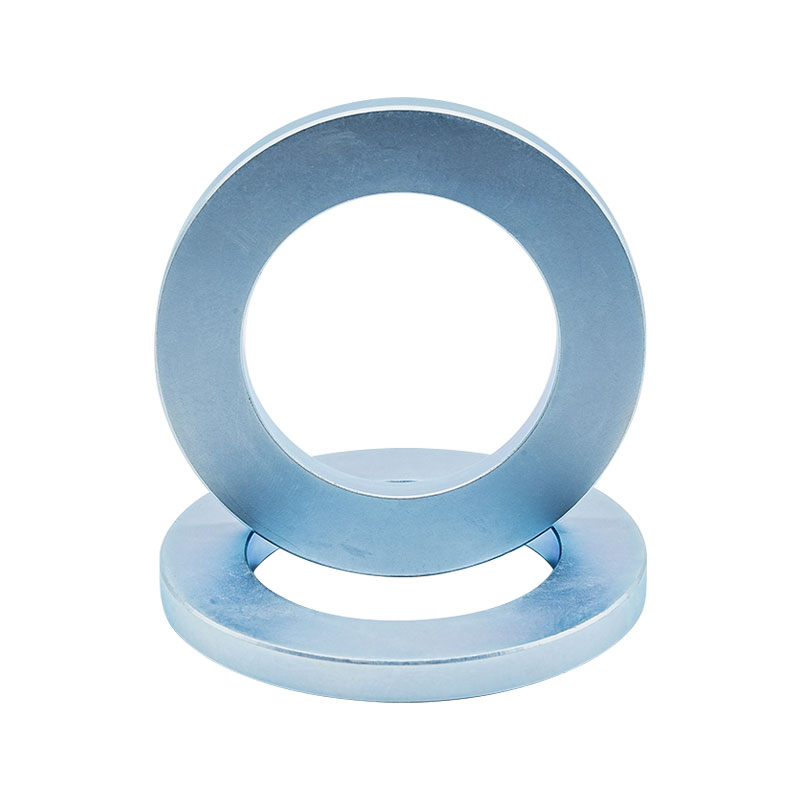 Ring Sintered NdFeB Supplier, ManufacturersAs a China Ring Sintered NdFeB manufacturers and custom Ring Sintered NdFeB manufacturers factory, Ningbo Jinlun Magnet specializes in Ri...View Product →
How to Calculate the Weight of an NdFeB Magnet
The calculation is straightforward: multiply the magnet's volume in cubic centimeters by the density in g/cm³ to get the mass in grams. The formula is Weight (g) = Volume (cm³) × Density (g/cm³).
Block magnet example
A 50 × 30 × 10 mm sintered NdFeB block has a volume of 15 cm³. At the standard density of 7.5 g/cm³, the weight is 15 × 7.5 = 112.5 g. That is why a sintered NdFeB block magnet of this size feels almost as heavy as a solid piece of iron.
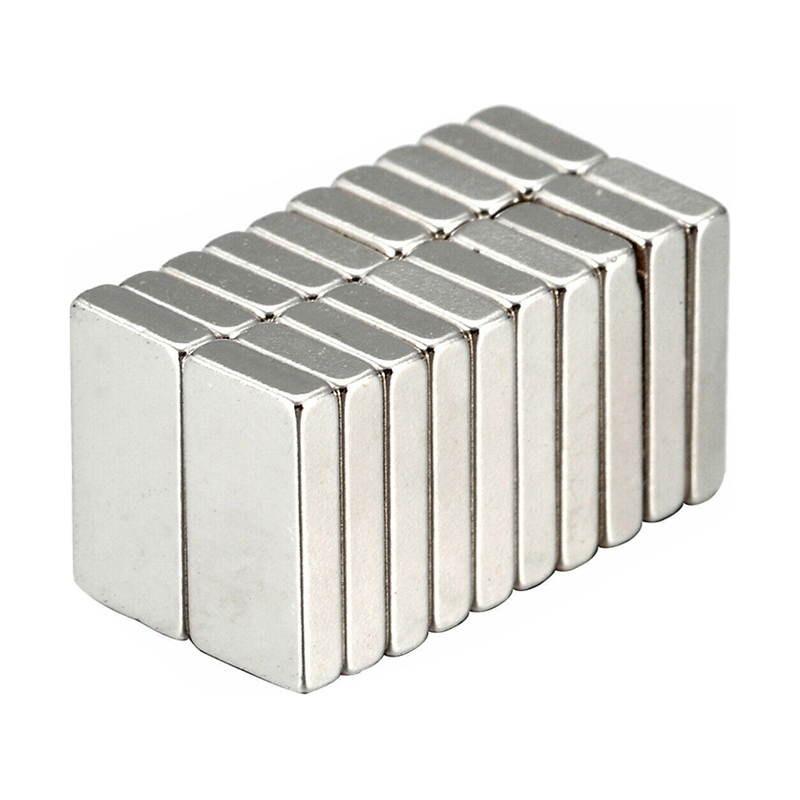 Block Sintered NdFeB Supplier, ManufacturersAs a China Block Sintered NdFeB manufacturers and custom Block Sintered NdFeB manufacturers factory, Ningbo Jinlun Magnet specializes in ...View Product →
Ring magnet example
A ring with an outer diameter of 40 mm, an inner diameter of 20 mm, and a height of 10 mm has a volume of about 9.42 cm³ (calculated as π × h × (R² - r²)). At the same density, the weight is approximately 70.7 g. The central hole is excluded from the volume calculation, which is a common source of estimation errors in procurement departments.
For irregular geometries, split the shape into simple volumes, calculate each one, and sum the results. A manufacturer will usually provide measured weight per part in the product parameter tables, which makes incoming inspection much easier.
What to Verify Before Buying on Density Alone
A density number on a datasheet is only trustworthy when it is backed by a controlled manufacturing process and a defined test method. Density alone does not tell you whether a magnet is good; combine it with flux, coercivity, and dimensional inspection.
- Verify the density against the actual part dimensions. If a machined block weighs more than the volume × 7.5 g/cm³ theory suggests, ask whether coating or plating is included.
- Request density test data for production lots when sourcing at volume. The Archimedes water displacement method is the common industry standard.
- Remember that density does not indicate magnetic strength. A magnet at 7.5 g/cm³ could be N35 or N52; the grade defines magnetic performance while density defines physical mass.
- Ask for a dimension drawing with the calculated theoretical weight per part so incoming inspection can confirm geometric and physical consistency at the same time.
For unusual geometries that are hard to calculate by hand, the supplier can assess density for you. A custom-shaped sintered NdFeB magnet is weighed and measured at the factory, so the theoretical weight and the actual weight rarely differ by more than 2–3% once machining tolerances and coatings are included.
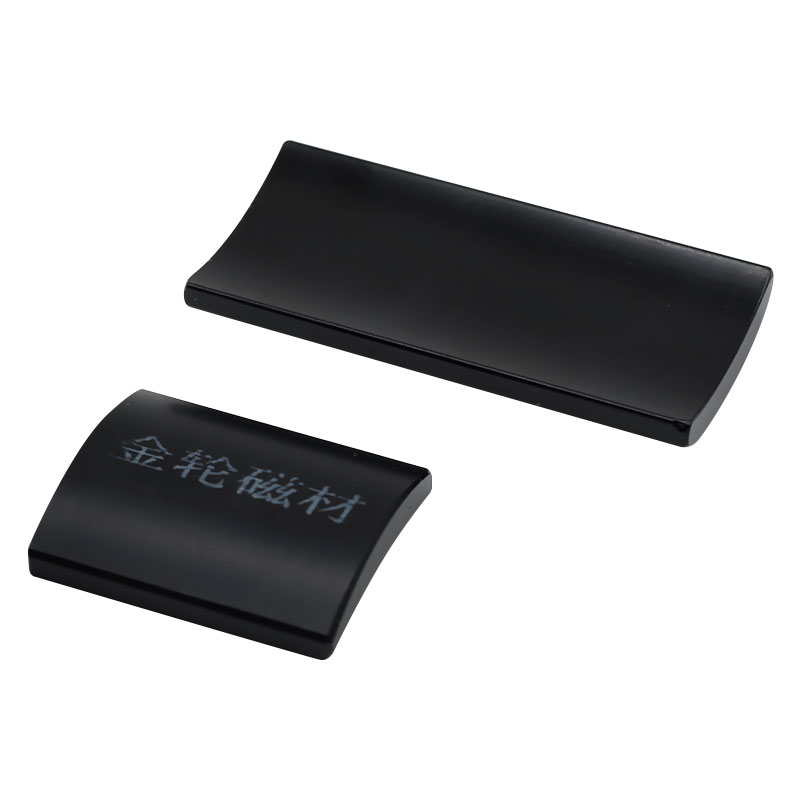 Custom Shape Sintered NdFeB Supplier, ManufacturersAs a China Custom Shape Sintered NdFeB manufacturers and custom Custom Shape Sintered NdFeB manufacturers factory, Ningbo Jinlun Magnet s...View Product →
Frequently Asked Questions About NdFeB Magnet Density
Is a higher NdFeB density always better?
Within the normal production range, higher density generally means a well-sintered body with minimal porosity. However, once the material reaches near-full density (about 7.5–7.6 g/cm³), additional gains are neither possible nor necessary. What matters is that the value falls inside the datasheet range, not that it sits at the top.
Does density differ between N35 and N52 grades?
No meaningful difference exists. Both grades use the same Nd₂Fe₁₄B phase and both reach about 7.4–7.6 g/cm³. What changes between grades is magnetic alignment, composition tuning, and process control, not physical density.
How do I convert NdFeB density into kg/m³?
Multiply the g/cm³ value by 1,000. A density of 7.5 g/cm³ equals 7,500 kg/m³, and the full production range of 7.3–7.7 g/cm³ equals 7,300–7,700 kg/m³.
Does density affect magnetic force directly?
Not directly. Magnetic force depends on remanence, coercivity, and magnet geometry. But if a magnet has abnormally low density from internal porosity, its effective magnetic cross-section is smaller, so flux output can drop. For more detail, read our guide on how to calculate the suction force of a strong neodymium magnet.
Is density the same for bonded and sintered NdFeB?
No. Bonded NdFeB, which mixes magnet powder with a polymer binder, has a density of roughly 5.5–6.2 g/cm³. Sintered NdFeB, made from a fully dense alloy, reaches 7.3–7.7 g/cm³. Do not use one value for the other when calculating part weight.