EN
EN English
 中文简体
中文简体 русский
 Deutsch
 日本語
日本語 한국어
한국어

A Halbach array is a special arrangement of permanent magnets that concentrates the magnetic field on one side of the assembly while nearly cancelling it on the opposite side. For engineers evaluating motor, generator, or magnetic coupling designs, this one-sided flux behaviour means higher usable field strength and a more compact assembly for the same magnet volume. The trade-off is equally clear: a Halbach array costs more to manufacture and demands precise magnetization and bonding, so specify it only when the performance gain justifies the complexity.
What Is a Halbach Array?
A Halbach array is a magnet configuration whose individual segments have magnetization directions that rotate in a deliberate sequence, producing a strong magnetic field on one side of the array and an almost zero field on the opposite side. The concept is named after Klaus Halbach, who developed the idea in the early 1980s at Lawrence Berkeley National Laboratory for particle accelerator magnets.
In a simple eight-magnet linear arrangement, the magnetization directions step through angles of 0°, 45°, 90°, 135°, 180°, 225°, 270°, and 315°. Neighbouring magnets do not all point the same way; instead, their fields combine constructively on the active side and cancel out on the rear side. Essentially, a Halbach array acts like a one-sided magnet.
The Magnetization Pattern
Four-segment and eight-segment patterns are the most common. A four-segment array uses 90° increments and is easier to manufacture, while an eight-segment array produces a smoother field on the strong side. In rotary designs, the pattern is repeated around the circumference to create the equivalent of a ring magnet with a controlled internal or external field.
How the Magnetic Field Is Distributed
Compared with a conventional array of identically oriented magnets, a Halbach array redistributes the magnetic field, concentrating it on the working side. It does not create extra magnetic energy; it simply makes the existing flux more useful for the application. The practical effect is a higher flux density in the air gap, reduced back-side flux leakage, and less interference with surrounding electronics.
| Parameter | Conventional Array | Halbach Array |
|---|---|---|
| Strong field side | Both sides | One side only |
| Stray field on rear side | High | Nearly zero |
| Flux density in working gap | Moderate | Higher for the same magnet volume |
| Motor torque density | Baseline | Improved |
| Assembly complexity | Low | High |
| Manufacturing cost | Lower | Higher |
Linear and Cylindrical Halbach Arrangements
Halbach arrays come in two main forms: linear and cylindrical. The choice depends on the geometry of the machine and where the strong field is needed.
Linear Halbach Arrays
A linear Halbach array is a flat strip of magnet segments in which the magnetization rotates along the length of the strip. Linear arrays are found in linear motors, magnetic conveyor tracks, and holding fixtures where a strong field is required on one face while the other face should be clean and field-free for mounting.
Halbach Cylinders and Rings
A cylindrical Halbach array is produced by arranging magnet segments around an axis so that the magnetization rotates around the circumference. This geometry generates a strong, relatively uniform field inside the bore and a very weak external field. Halbach cylinders are widely used in brushless rotary motors, magnetic couplings, permanent-magnet bearings, and compact NMR and low-field MRI systems.
Halbach Spheres
The three-dimensional Halbach sphere is a less common variant that produces an extremely uniform field inside a spherical cavity. Its complexity and cost limit it mostly to research instruments.
Key Benefits of Halbach Arrays
For design engineers, the value of a Halbach array shows up in five measurable ways.
- Higher effective field strength: The working air gap reaches a higher flux density for the same magnet volume, which can reduce magnet mass.
- Low stray field: The rear side of the array is nearly field-free, protecting sensitive electronics and reducing eddy-current losses.
- More compact machines: Because the field is concentrated on one side, housings and back-iron structures can be made smaller and lighter.
- Improved motor efficiency: PM synchronous and servo motors with Halbach rotors can deliver higher torque density for the same frame size.
- Field-free mounting surfaces: In holding and fixture applications, the inactive side creates a convenient surface for mounting without magnetic interference.
Drawbacks and Design Considerations
A Halbach array is not always the most economical solution. The performance gains come with manufacturing and reliability challenges that must be evaluated early in the design phase.
- Difficult assembly: Adjacent segments repel each other strongly, so assemblers need dedicated fixtures to avoid misalignment.
- Custom magnetization required: Each segment must be magnetized in a specific direction, which calls for custom tooling and longer lead times.
- Tolerance sensitivity: Small errors in dimensional tolerance or magnetization angle weaken the field on the strong side and disrupt the cancellation on the weak side.
- Demagnetization risk: During assembly, segments are exposed to high opposing fields, which can partially demagnetise standard N-grade NdFeB magnets if handling is not controlled.
- Higher cost: Machining, magnetizing, bonding, and testing multiple segments costs more than producing a single solid magnet of the same volume.
When specifying a Halbach assembly, work with a magnet manufacturer that controls the entire process, from segment material grade to magnetization and final field verification. A reputable supplier should document the surface field profile and the flux density in the intended air gap.
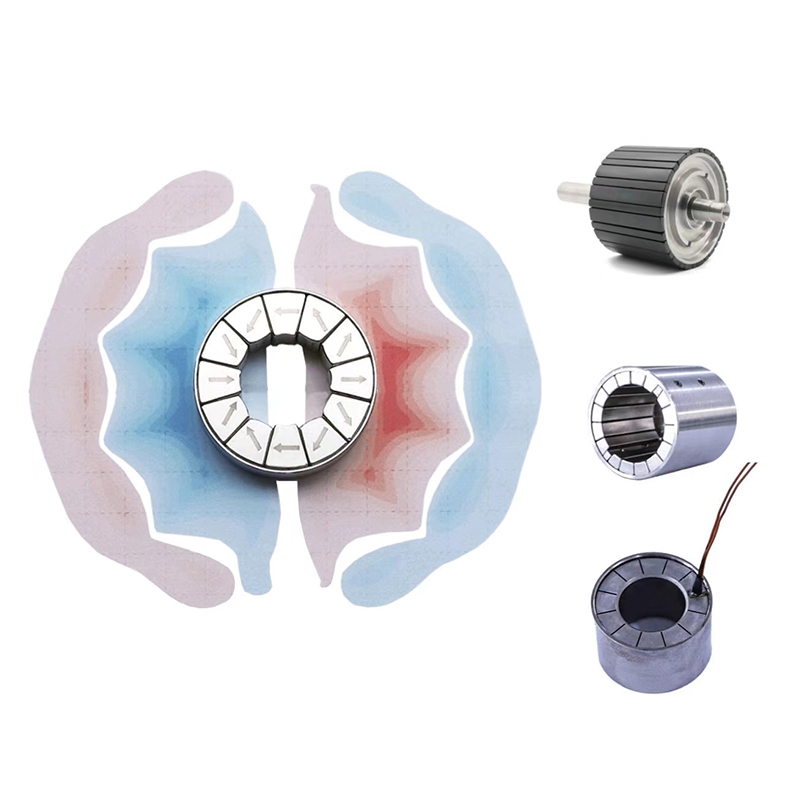 Halbach Array Magnetic Assemblies from a Full-Process Magnet ManufacturerThis supplier covers everything from material grade to magnetization and field verification, which matters when specifying a Halbach assembly that needs a documented surface field profile and air-gap flux density.View Product →
Main Applications of Halbach Arrays
Halbach arrays appear in products where compactness, efficiency, or field shaping matters more than minimising the raw magnet cost.
Motors and Generators
The most common industrial application is the permanent-magnet synchronous motor. In a Halbach rotor, the field is directed toward the stator and suppressed toward the rotor shaft, which reduces the amount of back-iron needed and raises torque density. The same principle improves the performance of servo motors, hub motors for electric vehicles, and compact generators.
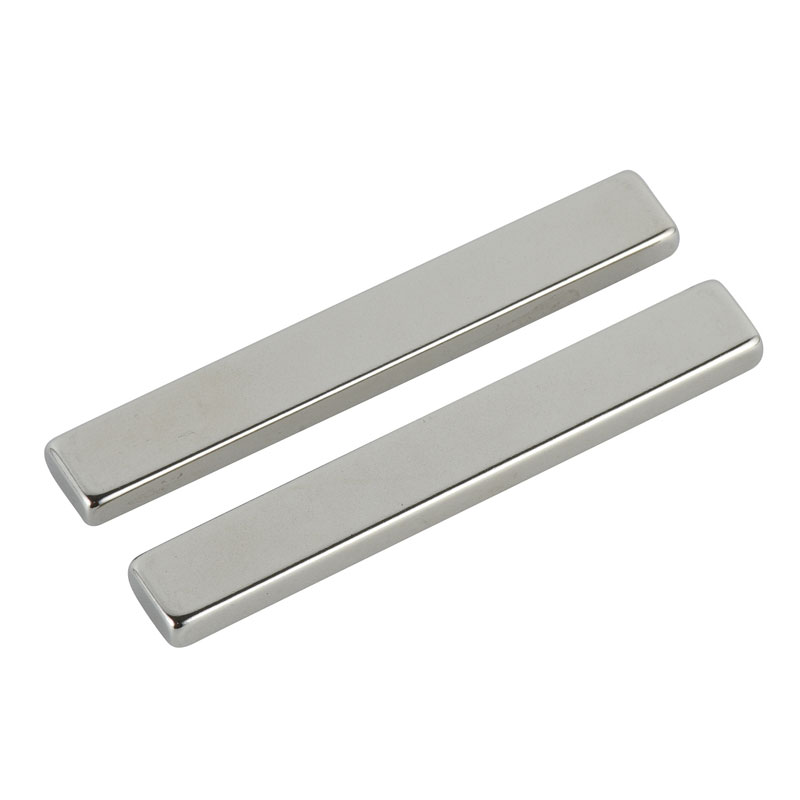 Sintered NdFeB Rotor Magnets for Permanent-Magnet Synchronous MotorsThese sintered magnets are made for synchronous motor applications, supporting the Halbach rotor designs that direct field toward the stator and reduce back-iron while raising torque density in servo, hub, and compact generator motors.View Product →
Wind Power Generators
Direct-drive permanent-magnet generators for wind turbines use large-diameter Halbach or quasi-Halbach rotor structures to achieve a strong air-gap field while minimising total magnet mass and structural weight. These assemblies help generators produce usable power at lower rotational speeds without a gearbox. For more detail, see this review of high-performance sintered NdFeB magnets in wind turbine generators.
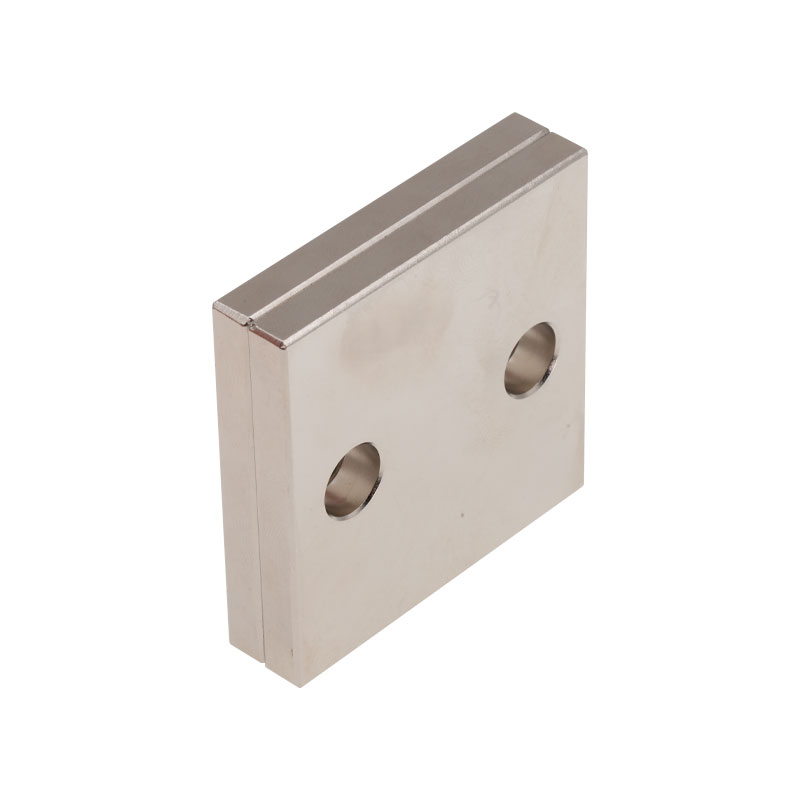 Sintered NdFeB Magnets for Direct-Drive Wind Turbine GeneratorsWind turbine generators rely on large Halbach or quasi-Halbach rotors to cut magnet mass and structural weight. These sintered magnets are produced for both onshore and offshore permanent-magnet generators, with thermal stability and dimensional accuracy for long-term service.View Product →
Magnetic Levitation and Bearings
Maglev transport research and magnetic bearing systems use linear and cylindrical Halbach arrays to create stable levitation forces without active electronic control.
Medical and Research Equipment
Halbach cylinders are used in portable NMR and low-field MRI instruments, and Halbach undulators and wigglers help generate synchrotron light in particle accelerators.
Consumer and Industrial Products
Refrigerator door gaskets contain a flexible Halbach-style magnetization pattern so the seal attracts to the cabinet on one side, while the inner face stays clean and free of magnetic particles. Magnetic clamps, fixtures, and work-holding plates use similar one-sided field behaviour.
What to Consider When Buying a Halbach Array
If you have decided that a Halbach array is the right approach, the procurement conversation needs to cover material, geometry, tolerances, and acceptance criteria.
- Magnet grade: Choose a sintered NdFeB grade with the right remanence and maximum energy product, typically N42 to N52, for high flux density applications.
- Temperature rating: Sintered NdFeB is available in N, H, SH, UH, and EH series with maximum working temperatures from about 80°C to over 200°C. Match the grade to the worst-case operating temperature.
- Coating: Nickel, zinc, and epoxy coatings each suit different environments. The coating thickness also changes the dimensional fit of assembled segments.
- Segmentation: More segments produce a cleaner field pattern but increase cost and assembly time. Confirm the minimum segment count that meets your field uniformity requirement.
- Tolerances and verification: Ground segments typically hold a dimensional tolerance of about ±0.05 mm. Ask for inspection reports and a magnetic field map of the finished array.
Reliable manufacturers should provide detailed product parameters so you can compare grades, dimensions, and performance data before placing an order.
Frequently Asked Questions
What is a Halbach array in simple terms?
A Halbach array is a pattern of permanent magnets that makes the magnetic field much stronger on one side of the pattern and almost zero on the other side.
Are Halbach arrays stronger on one side?
Yes. The flux from every segment combines on the active side of the array and cancels on the rear side, so the effective field is highly asymmetric.
What are Halbach arrays used for?
Typical uses are permanent-magnet motors, wind turbine generators, magnetic couplings, magnetic bearings, portable NMR and low-field MRI systems, maglev research, and one-sided holding fixtures.
Do Halbach arrays create more magnetic energy?
No. They redistribute the existing field rather than increasing the total energy, but the concentrated field on the working side can be more effective than the symmetric field of a conventional block arrangement.
Why are Halbach arrays expensive?
The higher cost comes from custom magnetization of each segment, precision machining, strong repulsive forces that complicate assembly, and the need for field verification testing after bonding.
A Halbach array is a powerful tool in permanent-magnet engineering, but only when the application genuinely benefits from a one-sided field. Evaluate the working gap, stray-field limits, temperature environment, and total assembly cost before committing to a design. With the right supplier and clear specifications, a Halbach array can reduce magnet mass, improve efficiency, and make your product measurably more competitive.