EN
EN English
 中文简体
中文简体 русский
 Deutsch
 日本語
日本語 한국어
한국어

A Halbach array magnet is a deliberate arrangement of permanent magnets in which the magnetization direction of each segment rotates relative to its neighbor, concentrating the magnetic field on one side of the array and nearly cancelling it on the other. The engineering conclusion is straightforward: a Halbach array delivers a stronger working-side field without adding magnet mass, which allows motors, generators, and magnetic couplings to be smaller, lighter, and more efficient. This article explains the working principle, compares linear and cylindrical configurations, covers real-world benefits and limits, and gives procurement teams a practical checklist for buying custom Halbach components.
How Does a Halbach Array Work?
The Halbach effect is a superposition phenomenon: when magnetized segments are arranged so that their polarity vectors rotate progressively, typically in 90-degree steps, the field lines add constructively on one face and cancel destructively on the opposite face. In a standard linear array, the magnetization directions cycle through up, right, down, and left. The strong side can reach roughly 1.5 to 2 times the surface field of a single magnet of the same grade, while the null side falls close to zero.
This behavior is not a property of the magnet material itself; it is entirely a function of geometry and magnetization pattern. Both sintered NdFeB and ferrite can be used, but the higher energy product of NdFeB is preferred in compact, high-performance designs. The same principle wraps around into a ring to form a Halbach cylinder, which produces a comparatively uniform field inside the bore and almost no external field.
Linear vs. Cylindrical Halbach Arrays
Halbach arrays fall into two basic geometries: planar (linear) and cylindrical (ring or arc). Linear arrays create a strong field across a flat surface and suit linear motors, magnetic tracks, and clamping fixtures. Cylindrical arrays, built from arc or ring segments, suit rotary motors, generators, and couplings where a uniform bore field with minimal leakage is required.
| Feature | Linear Halbach Array | Cylindrical Halbach Array |
|---|---|---|
| Geometry | Flat strip of block magnets | Ring or arc segments around a bore |
| Field direction | Strong on one flat face | Uniform inside the bore |
| Typical field gain | Up to roughly 1.5–2x a single magnet | Up to roughly 1.4x a single magnet |
| Primary uses | Linear motors, magnetic tracks, fixtures | Rotary motors, generators, MRI, couplings |
| Assembly complexity | Moderate | High: curved segments and tight tolerances |
Choose a linear configuration when the active surface is flat, and a cylindrical one when the working field must be enclosed in a bore. In both cases the array only delivers its full benefit when the magnetization pattern is manufactured precisely; orientation errors of even a few degrees reduce the strong-side field and increase leakage on the null side.
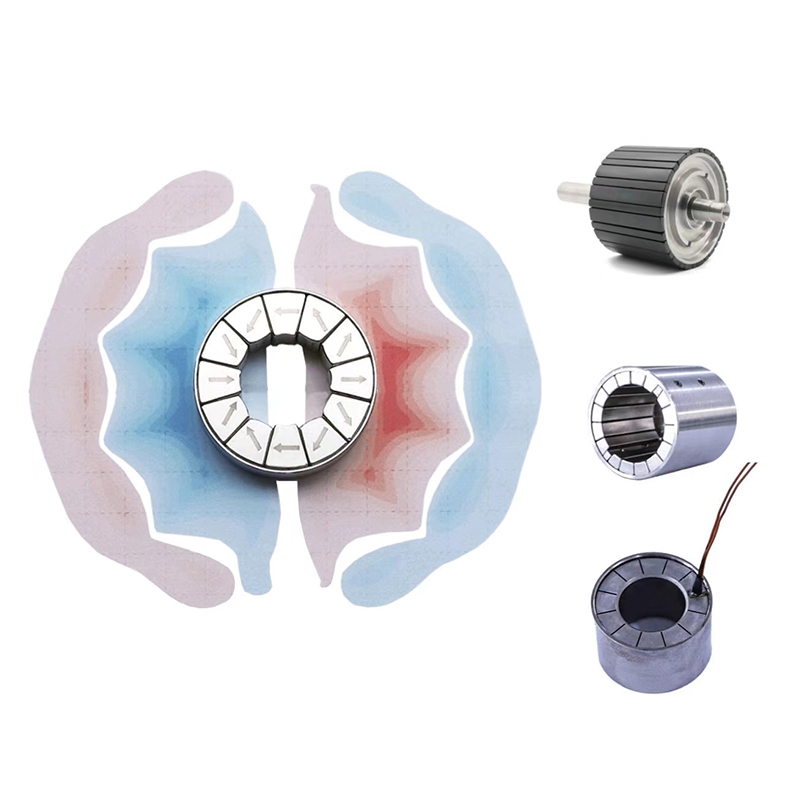 Halbach Array Magnet Manufacturer by Ningbo JinlunThis supplier offers Halbach array assemblies that concentrate magnetic flux on one side while suppressing the other, supporting motor, levitation, and precision sensing applications with consistent magnetization.View Product →
Key Benefits of Halbach Array Magnets
Halbach arrays improve flux concentration, reduce stray fields, and remove the need for heavy back-iron in many assemblies, which translates into better efficiency and lower system weight. These are the benefits that justify the higher piece cost in demanding applications.
- Higher working flux density. Concentrating flux on the working side raises air-gap flux without adding magnet volume, increasing torque density in motors.
- Self-shielding. The near-zero back-side field eliminates the need for back-iron yokes in some designs, cutting weight and material cost.
- Smoother rotation. Halbach rotors typically show lower cogging torque and lower torque ripple than conventional surface-magnet rotors.
- Better large-gap performance. When the gap between rotor and stator grows, the concentrated field holds its strength longer than a conventional unidirectional array.
The trade-off matters: a Halbach array is not always better than a standard two-pole assembly. Its advantage depends on the air gap, the number of segments, and whether stray-field shielding is actually necessary. Evaluate the full magnetic circuit rather than only the surface field reading before choosing this configuration.
Practical Drawbacks and Design Constraints
The main drawbacks of Halbach arrays are higher manufacturing cost, mechanical fragility, and complex magnetization requirements. Because every segment needs a precisely controlled magnetization vector, production requires tight tolerances, custom fixtures, and usually a dedicated magnetizing fixture that is not shared with standard products.
- Cost per unit. Precisely oriented segments and custom magnetizing tooling raise the piece price.
- Mechanical brittleness. Sintered NdFeB is hard but brittle, and assembly under strong attraction forces causes chipping if it is not controlled.
- Demagnetization risk. Thin segments oriented against the field direction can be partially demagnetized by adjacent magnets when the material grade is mismatched.
- Handling safety. Uncontrolled closing forces on small arrays can exceed 100 kg, creating serious pinch and projectile hazards.
For this reason, most industrial buyers do not assemble Halbach arrays from loose blocks. They order pre-magnetized sub-assemblies from a manufacturer that controls the magnetization sequence and verifies the finished field distribution.
Where Halbach Array Magnets Are Used
Halbach arrays are used wherever a strong contained field saves weight, reduces stray emission, or improves efficiency. The most common industrial applications are motors, generators, and magnetic couplings, but the list extends into medical and scientific equipment.
| Application | Benefit from the Halbach configuration |
|---|---|
| Synchronous and servo motors | Higher torque density and lower cogging torque |
| Wind-turbine generators | Lightweight rotor, lower structural load on the tower |
| Magnetic couplings | Limited stray field, safer operation if the coupling breaks |
| MRI and NMR devices | Uniform bore field with low external leakage |
| Particle accelerators (wigglers) | Compact periodic fields in a small envelope |
| Refrigerator door gaskets | One-sided attraction keeps the door sealed without affecting nearby items |
In motor applications, arc-shaped NdFeB segments arranged as a Halbach cylinder allow the rotor to generate a strong sinusoidal air-gap field while the back side needs no iron yoke. That geometry is particularly valuable in electric vehicle traction motors and high-speed spindle motors, where rotor mass directly limits dynamic performance.
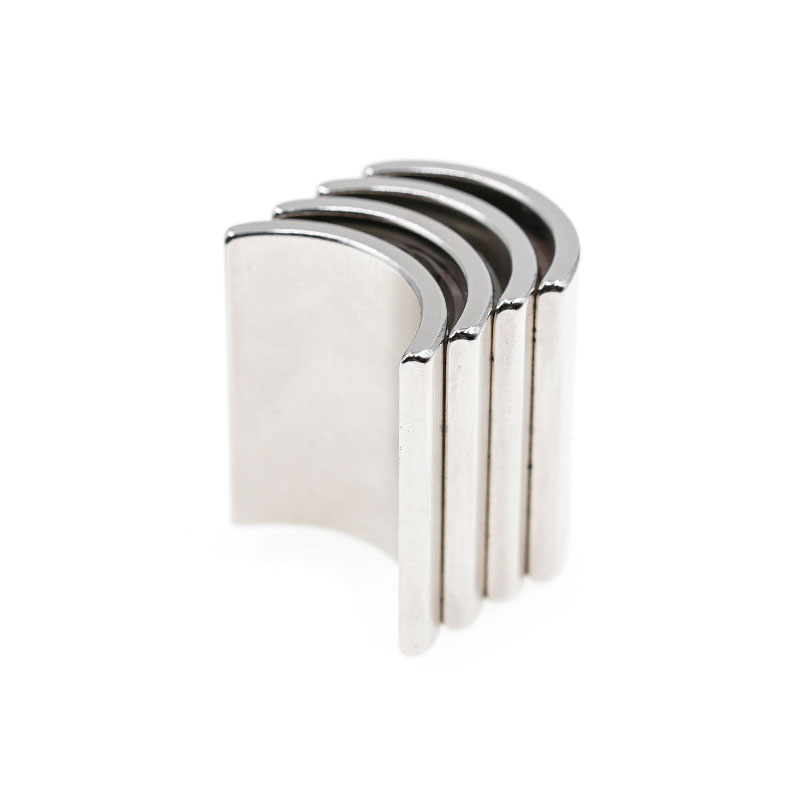 Arc and Tile NdFeB Segments for Motor RotorsThese curved permanent magnets match rotor circumference to improve flux use and reduce air-gap loss, making them suitable for synchronous, brushless DC, and servo motor designs.View Product →
How to Specify and Buy Halbach Array Magnets
Sourcing rule: buy Halbach arrays from a manufacturer that controls the full process chain, including sintering, precision shaping, magnetization, and field verification. If any step is outsourced, the magnetization pattern is very difficult to keep consistent, and field defects only appear after final assembly.
When requesting a quotation, define five things clearly:
- Array geometry — linear, cylindrical, or arc-segment set; dimensions of each segment and the overall assembly envelope.
- Magnet grade and temperature class — for example N42SH or N45H depending on maximum operating temperature and required coercivity.
- Magnetization pattern — number of poles, rotation direction of each segment, and allowable error in orientation angle.
- Surface treatment — NiCuNi for general use, epoxy or PTFE for humid environments, zinc for cost-sensitive parts.
- Field verification criteria — target surface field in mT or gauss, acceptable null-side leakage, and the inspection method.
| Grade | Remanence (Br, approx.) | Max operating temperature | Best suited to |
|---|---|---|---|
| N42 | 1.30–1.34 T | 80°C | Room-temperature motors and couplings |
| N45 | 1.33–1.38 T | 80°C | High-flux, cool-running designs |
| N42SH | 1.28–1.32 T | 150°C | Automotive motors and generators |
| N38EH | 1.22–1.26 T | 200°C | High-temperature industrial equipment |
The price difference between a Halbach array and an equal number of loose magnets is mostly the custom magnetizing fixture and field inspection. In prototypes, that fixture dominates the cost; in production volumes it is amortized, and the array becomes competitive once the removed shielding weight and reduced stray-field problems are factored into the system cost.
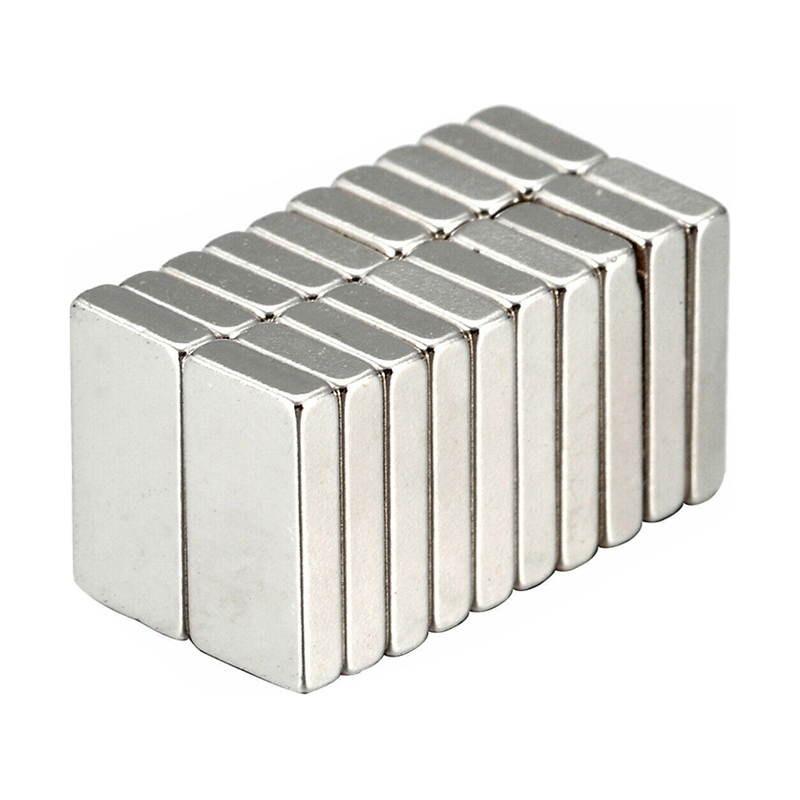 Sintered NdFeB Block Magnets for AssembliesThese block magnets serve as the core elements in custom arrays, where precise magnetization and field inspection determine performance, with costs balanced by reduced shielding weight in production.View Product →
Halbach Array Magnets: FAQ
Is a Halbach array stronger than a single magnet of the same size?
On the working side, yes. The array concentrates the field so the strong side can reach up to roughly twice the surface field of one magnet. On the back side it is much weaker. The array is directional, not uniformly stronger.
Does the null side attract ferromagnetic materials?
Not significantly. Cancelling the back-side field is the defining property of the arrangement, so a steel object placed near the null side experiences little or no attraction. This is why Halbach assemblies are chosen when stray-field contamination must be avoided.
Can I assemble a Halbach array from individual magnets?
You can, but it is rarely wise outside a small bench test. The forces between segments make positioning difficult, and a single wrong magnetization orientation breaks the whole pattern. For a reliable result, buy a pre-magnetized sub-assembly from a manufacturer with controlled tooling.
What material is best for a Halbach array?
Sintered NdFeB is the standard because of its high energy product and straight demagnetization curve. Ferrite works when cost dominates and temperature is moderate, but it requires larger segments to reach an equivalent flux density.
Halbach array magnets reward careful design and disciplined manufacturing. When the magnetic circuit needs a one-sided field, a lightweight rotor, or low stray emission, the configuration pays for itself through system-level weight and efficiency savings. When those needs are absent, a conventional magnet arrangement remains simpler and cheaper. Match the configuration to the magnetic circuit, and the Halbach array becomes a precise engineering tool rather than a trendy design idea.