EN
EN English
 中文简体
中文简体 русский
 Deutsch
 日本語
日本語 한국어
한국어

A Halbach array is a magnetic arrangement that cancels the magnetic field on one side and concentrates it on the other side. It is not a special magnetic material; it is a pattern of magnetization directions that gives you a more useful field with less stray flux. For engineers and buyers working with permanent magnets, a Halbach array is one of the most effective ways to improve system performance without enlarging the magnetic assembly.
Sintered neodymium magnets are the most common building blocks for Halbach arrays because they combine high energy density with stable, customizable magnetization. Whether you are designing a motor rotor, a wind turbine generator, or a magnetic holding system, the Halbach pattern can reduce leakage, increase torque, and help you meet strict space and weight targets.
What Is a Halbach Array?
A Halbach array is a repeating magnetic structure in which each magnet block is magnetized in a direction rotated relative to its neighbour, typically by 90 degrees. This rotation creates a field that adds on one side of the array and cancels on the opposite side.
In a simple linear Halbach array, four blocks in a row might have magnetization directions up, right, down, and left. The magnetic flux is strong above the row and very weak below it. In a cylindrical Halbach array, the same principle is applied around a ring. The field is concentrated inside the bore and almost zero outside, which is why cylindrical Halbach arrays are used in motors and high-field devices.
Key characteristics of a Halbach array include:
- One-sided magnetic flux concentration
- Low stray field on the inactive side
- Higher field strength per unit of magnet mass
- Reduced back-iron or shielding requirements
- Smoother, more sinusoidal field distribution for rotary machines
This one-sided field pattern was first developed for particle accelerators and is now common in industrial motors, generators, and magnetic assemblies.
Why Use a Halbach Array?
You use a Halbach array when you need a stronger field on the working side and a weaker field on the back side, or when you want to improve efficiency in a limited space. It gives you the field performance of a larger magnetic assembly in a more compact package.
- Higher flux density: The active side of a well-designed Halbach array can deliver a significantly stronger field than the same magnets arranged conventionally.
- Less stray field: Reducing the field on the inactive side minimizes interference with nearby sensors, electronics, and magnetic components.
- Lighter construction: Because less magnetic material and less shielding are needed, the total assembly can be smaller and lighter.
- Better motor performance: In brushless motors, a Halbach rotor increases torque per ampere and reduces cogging torque, which improves smoothness and positional accuracy.
- Energy savings: Higher flux utilization means lower resistance losses in the stator for the same mechanical output.
These advantages explain why Halbach arrays are no longer limited to advanced laboratory equipment. They are now a practical design option for industrial magnetic components.
Halbach Array vs. Conventional Magnet Array
To understand the value of a Halbach array, compare it with a simple two-pole or multi-pole magnet arrangement.
| Aspect | Conventional Array | Halbach Array |
|---|---|---|
| Field distribution | Strong on both sides | Strong on one side, weak on the other |
| Stray field leakage | Higher | Lower |
| Flux utilization | Moderate | High |
| Torque density in motors | Baseline | Higher for the same rotor size |
| Magnet mass required | More for same active flux | Less |
| Manufacturing complexity | Lower | Higher |
| System-level cost | Higher shielding and assembly costs | Lower in many compact designs |
The trade-off is not in the material itself but in manufacturing precision. A Halbach array must have the correct magnetization direction in every block. Slight errors reduce field cancellation and may create hot spots. This is why selecting a magnet supplier with tight dimensional and magnetization control is essential.
Where Are Halbach Arrays Used?
Halbach arrays are used anywhere a strong, controlled magnetic field is needed inside a small volume or where external stray fields must be minimized. The most common applications include:
- Brushless DC motors and synchronous motors
- Wind turbine generators
- Magnetic couplings and clutches
- Magnetic bearings
- MRI and particle accelerator components
- Magnetic holding and lifting systems
- Sensors, actuators, and voice coil motors
In motor design, a Halbach array helps create a more sinusoidal air-gap field. That reduces torque ripple, improves efficiency, and allows a thinner rotor. Many synchronous motors now use Halbach magnet rings or segmented Halbach components instead of a conventional arrangement of surface-mounted magnets.
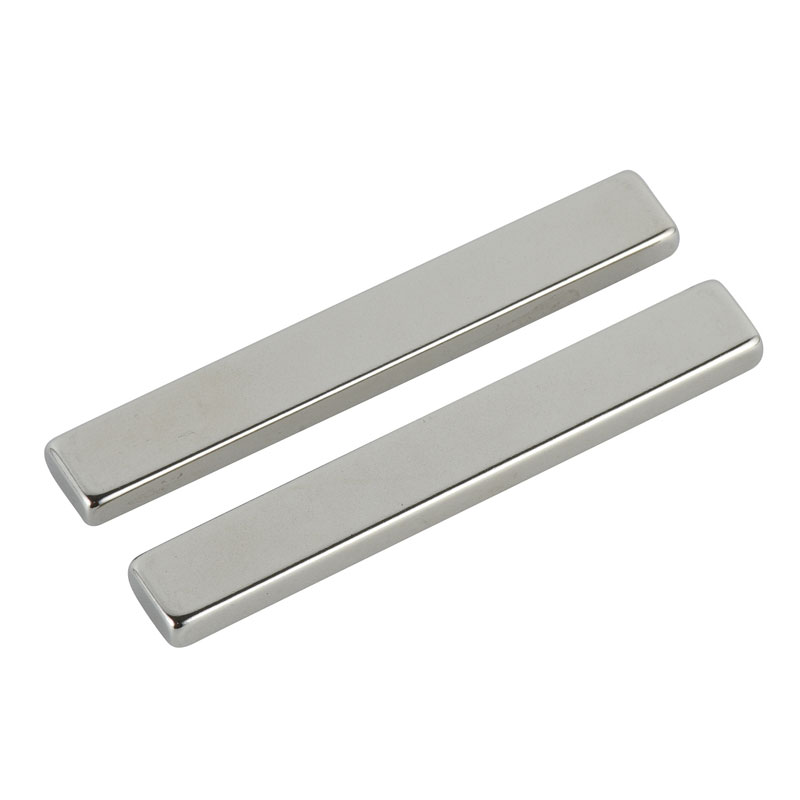 Sintered NdFeB Magnets for Synchronous Motor ApplicationsThis product page focuses on sintered neodymium magnets tailored for synchronous motors, covering performance features like high remanence and thermal stability. It is useful when evaluating magnet options that support low torque ripple and efficient motor operation.View Product →
Wind turbines use similar magnet topologies in permanent-magnet generators. A radial Halbach array inside the rotor concentrates flux through the stator coils and limits magnetic leakage outside the machine. The result is improved power density and lower magnetic interference with nearby control electronics.
Design and Material Considerations for a Halbach Array
The performance of a practical Halbach array depends on several factors: magnet grade, magnetization pattern, dimensional tolerance, working temperature, and surface protection.
1. Magnetic grade
Sintered NdFeB grades are selected primarily by remanence and coercivity. Higher remanence gives more flux, but the maximum working temperature is usually lower for the highest-energy grades. Match the grade to the motor or generator duty cycle.
2. Temperature range
Sintered NdFeB can demagnetize if the operating temperature exceeds the material limit. Check the working temperature of sintered NdFeB before finalizing the grade for a Halbach array.
3. Magnetization direction
Each block in the array must be magnetized through the required axis, sometimes at angles such as 0°, 45°, 90°, or 135°. The magnet manufacturer must be able to set and verify these directions consistently across the whole batch.
4. Dimensional tolerance and coating
Tight length, width, and thickness tolerances are needed so the blocks sit accurately against each other. A nickel, zinc, or epoxy coating protects the magnet surface from corrosion and handles the assembly process.
5. Magnetic property verification
Before production, review physical properties and demagnetization curves to confirm that the supplied material meets the design assumptions. For complete Halbach components, test the assembled field strength and pole pattern after magnetization.
If you prefer to buy a complete Halbach component instead of lining up individual blocks, an experienced NdFeB manufacturer can produce the component with the magnetic pattern already integrated.
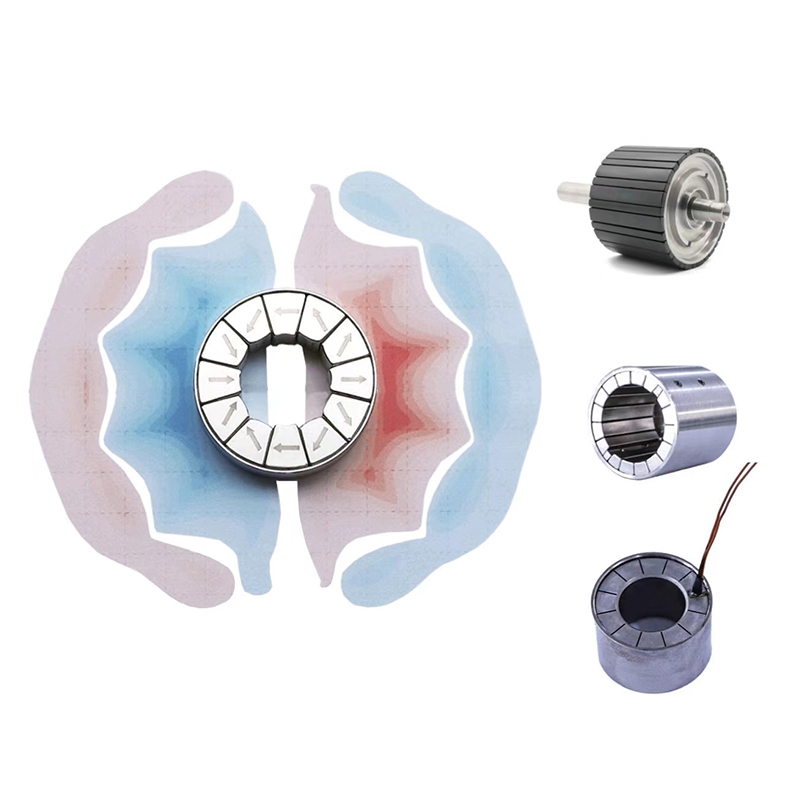 Halbach Array Components from Experienced Magnet ManufacturerThis listing presents ready-made Halbach components with integrated magnetization patterns, ideal for buyers seeking a complete assembly rather than individual blocks. The page explains how such components improve field utilization and reduce energy loss in precision systems.View Product →
How to Source a High-Quality Halbach Array
Sourcing a Halbach array is not the same as buying standard magnet blocks. You need a supplier that can control magnetization direction, hold tight tolerances, and provide traceable magnetic performance data.
Start with a clear specification:
- Define the magnetic circuit: linear or cylindrical, number of poles, inner/outer diameter, and length.
- Select the NdFeB grade and temperature class based on the demagnetization curve.
- Specify the coating and tolerances for each magnet block or component.
- Ask for the magnetization direction on the drawing and agree on a test method.
- Confirm whether you need flux mapping or a final assembly test.
A supplier with in-house sintering, machining, plating, and magnetization can reduce lead time and eliminate tolerance mismatches. It also makes it easier to adjust the design when you move from prototype to mass production.
Frequently Asked Questions About Halbach Arrays
Does a Halbach array require more magnet material?
No. A Halbach array uses the same magnet material more effectively. It concentrates flux on the active side and cancels it on the inactive side, so you can often use less material and still achieve the required field.
Can a Halbach array be made from any permanent magnet?
Yes, but sintered NdFeB is usually the best choice because of its high remanence and the ability to magnetize blocks in multi-directional patterns. Ferrite and alnico can also be used, but they need more volume for the same field strength.
What is the difference between a linear and a cylindrical Halbach array?
A linear Halbach array concentrates field on one side of a flat assembly. A cylindrical Halbach array concentrates the field inside the bore and cancels it outside. Cylindrical arrays are common in motors, generators, and couplers.
How much stronger is the active side of a Halbach array?
In practical motor and generator designs, the active-side flux density can be 30 to 50 percent higher than a conventional magnet arrangement using the same magnet volume. The exact gain depends on the pole count, air gap, and magnetic circuit geometry.
A Halbach array is a smart way to shape a magnetic field. It gives you one strong side, one quiet side, and better flux utilization. The engineering benefits are clear, but the quality of the result depends on precision magnetization and careful material selection.
When you plan a Halbach array, work with a manufacturer that understands both magnet design and production tolerances. The right supplier will help you choose the correct grade, coating, magnetization pattern, and component form so your system achieves the performance you expect.