EN
 English
 中文简体
 русский
 Deutsch
 日本語
 한국어


A magnet's Curie point, also written as the Curie temperature or Tc, is the temperature above which the material stops being ferromagnetic and turns paramagnetic, losing its spontaneous magnetization. For sintered NdFeB that figure sits near 310–340 °C; for samarium-cobalt it is closer to 720–800 °C. That number is a material constant, not a design limit, and treating it as a working ceiling is how rotors, sensors and actuators end up quietly underperforming.
The practical answer is shorter: design to the maximum operating temperature, not to the Curie point. A standard N42 rotor magnet that never approaches 320 °C can still surrender a measurable share of its flux after a single excursion past roughly 80–100 °C. The rest of this article explains why the two numbers differ, how each one is set, and what to verify on a datasheet before you commit to a grade.
What the Curie Point Actually Means
At the Curie point, thermal energy becomes strong enough to overcome the exchange coupling that holds neighbouring atomic moments parallel, and the material's spontaneous magnetization collapses. Below Tc those moments stay aligned inside magnetic domains. Above it, thermal agitation randomizes them and the material behaves as a paramagnet that can neither attract nor generate a field of its own.
Below the Curie Point, a Magnet Is Already Losing Strength
Reversible loss begins at room temperature. Sintered NdFeB loses remanence at roughly 0.11% per °C, and intrinsic coercivity falls faster still, typically 0.5–0.65% per °C. Samarium-cobalt is far more stable, with a remanence coefficient near 0.03% per °C. That difference in slope, not the Curie point, is what separates a magnet that holds tolerance in a hot gearbox from one that drifts out of specification.
At the Curie Point, the Magnetism Itself Disappears
Above Tc there are no domains left to align: the material cannot be pulled by a field and cannot produce one. In an ideal laboratory cycle the effect is reversible, because cooling the sample back down with its chemistry and microstructure intact restores ferromagnetism. In a real assembly it usually is not. A magnet that reaches Tc inside a rotor, pump or fixture is surrounded by demagnetizing fields from adjacent poles, so the assembly generally has to be re-magnetized. Any epoxy, coating, insulation or bearing damage caused by the same thermal event is permanent regardless.
Curie Point vs Maximum Operating Temperature
These are different quantities, established by different methods. The Curie point is a fixed property of the alloy. The maximum operating temperature is the point at which a specific grade, in a specific circuit geometry, still operates above the knee of its demagnetization curve.
| Material | Typical Curie point | Typical max operating temperature | What it means in practice |
|---|---|---|---|
| Sintered NdFeB, standard N grade | 310–340 °C | 80 °C | Highest energy density, least thermal headroom. |
| Sintered NdFeB, SH to EH grades | 320–360 °C | 150–200 °C | Dy or Tb added at the grain boundaries; coercivity rises far more than Tc. |
| Samarium-cobalt, Sm2Co17 | 720–800 °C | 250–350 °C | Flux barely moves with heat; cost and material supply are the trade-off. |
| Sintered ferrite | ~450 °C | 250 °C | High Tc but low remanence, so the thermal margin is bought back in volume. |
| AlNiCo | 800–860 °C | 450–550 °C | Very high Tc, very low coercivity; easily demagnetized in a reverse field. |
| Iron (reference) | 770 °C | — | The textbook figure most people remember. |
| Nickel (reference) | 358 °C | — | Useful for teaching, not for motors. |
Why the Gap Is So Wide
The working limit is set by the knee point of the demagnetization curve, not by the disappearance of magnetism. As temperature rises, intrinsic coercivity drops, the knee shifts to the right, and the load line can slide past it. At that moment the magnet demagnetizes irreversibly even though it may still be 200 °C below its Curie point. Thin magnets with a low permeance coefficient reach that knee first, which is why geometry matters as much as grade.
Temperature-dependent behaviour for a specific grade is best checked on the published demagnetization curves for each material.
Can You Raise the Curie Point of NdFeB?
Only marginally, and that is precisely the point. Substituting dysprosium or terbium for neodymium lifts the Curie temperature of the 2:14:1 phase by roughly 10–15 °C overall, from about 312 °C for Nd2Fe14B to roughly 325 °C where dysprosium dominates. The same substitution raises the anisotropy field, and therefore intrinsic coercivity, by a far larger factor.
Grain Boundary Diffusion Changes Coercivity, Not Tc
Grain boundary diffusion drives Dy or Tb along grain boundaries instead of through the whole grain. It raises coercivity with much less heavy rare earth, keeps remanence higher, and leaves the Curie point essentially where it was. When a supplier advertises a high-temperature NdFeB grade, the real gain is in coercivity and knee position rather than in Curie temperature.
Where High Curie Points Genuinely Come From
Materials with truly high Tc owe it to crystal structure and the cobalt sublattice. Sm2Co17 reaches roughly 800 °C because Co-Co exchange coupling is strong and the anisotropy is high enough to survive it. That is why applications above 200 °C still tend to land on samarium-cobalt or a carefully engineered NdFeB grade rather than a "better" neodymium recipe.
Selection Rules That Keep You Clear of Tc
Work from the hot end of the duty cycle and treat the Curie point as a background safety reference, not a target. The following checks catch most thermal failures long before they reach a prototype.
- Start from worst-case temperature: ambient plus copper losses plus a stall or short-circuit event, held for as long as the protection takes to trip.
- Read the demagnetization curve at that temperature and work from the knee, not from remanence. Remanence tells you the flux when cold; the knee tells you whether the flux survives.
- Keep the permeance coefficient above the knee. Thin discs in open circuits and magnets at the end of a long air gap demagnetize first.
- Compare temperature coefficients rather than Tc alone. NdFeB at about −0.11% per °C and SmCo at about −0.03% per °C behave very differently across a 150 °C swing.
- Specify the coercivity grade you need, not the energy grade. N42 and N42SH share nearly the same remanence and behave completely differently at 150 °C.
- Soak-test at worst-case temperature plus margin and measure flux before and after. A 24-hour soak at 20 °C above the intended limit is a cheap way to expose irreversible loss early.
For a closer look at how temperature interacts with grade selection in sintered material, the working temperature of sintered NdFeB is a useful reference point.
Block and rectangular formats remain the workhorses for pole pieces, linear actuators and holding fixtures. Suppliers such as Ningbo Jinlun Magnet Technology produce standard and custom block sintered NdFeB with grade, tolerance and coating matched to the duty cycle rather than to the catalogue headline.
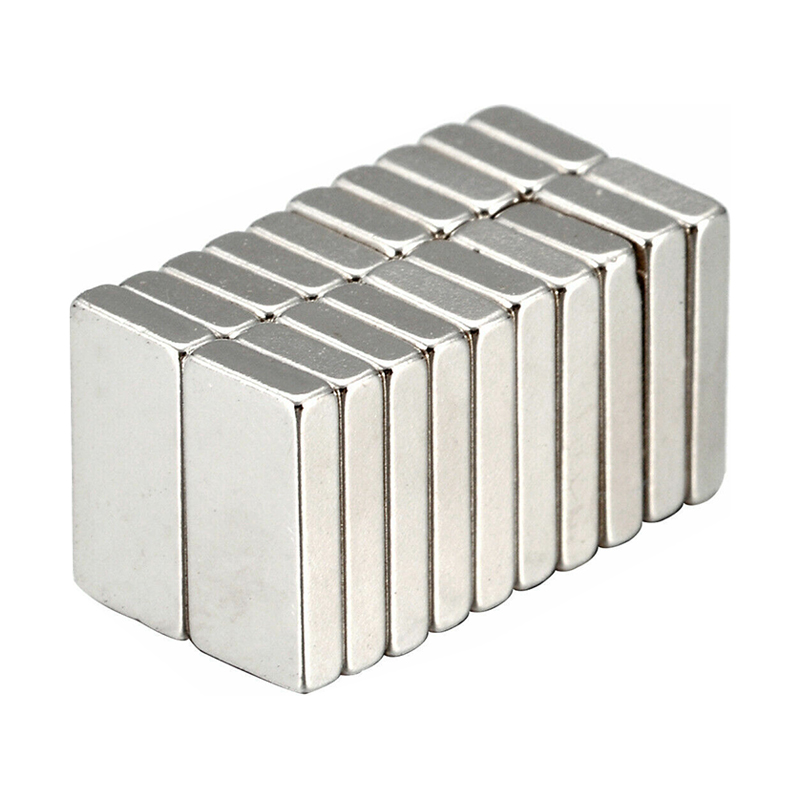 Block Sintered NdFeB Permanent MagnetsBlock sintered NdFeB magnets offer high magnetic energy, strong coercivity, and dimensional stability for pole pieces, linear actuators, holding fixtures, and custom assemblies.View Product →
Matching the Magnet to the Application
Temperature is one axis and the magnetic circuit is the other. The same grade that is perfectly safe inside a closed rotor lamination can be marginal in a bare sensor target with no flux return path.
Motors and Generators
Synchronous motors, traction drives and direct-drive wind generators use NdFeB for its energy density, and their thermal design is dominated by rotor temperature and the demagnetizing field from the stator. Keeping the load line above the knee at the hottest expected rotor temperature, not at the inlet air temperature, is the single most effective safeguard.
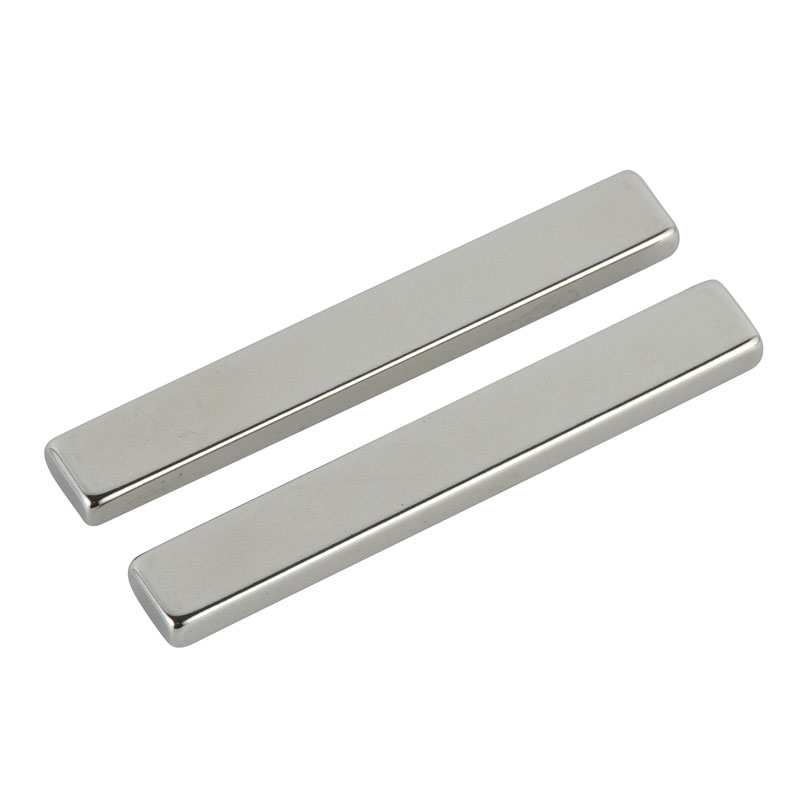 Sintered NdFeB Magnets for Synchronous Motor ApplicationsHigh-remanence, high-coercivity sintered NdFeB magnets for synchronous motor rotors, supporting compact high-torque designs in EV traction, industrial drives, and wind generators.View Product →
Sensor Targets and Magnetic Assemblies
Halbach arrays, magnetic couplings and position-sensor targets often run in confined spaces with poor heat paths. In these designs a segmented Halbach ring can deliver a stronger air-gap field with less magnet volume, which lowers both cost and the temperature the material actually sees.
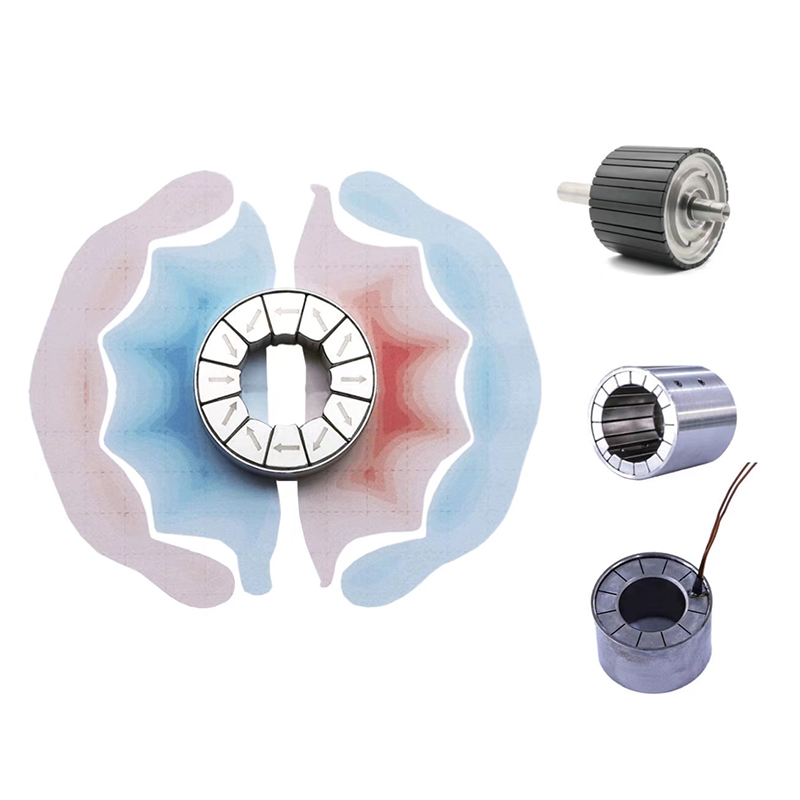 Halbach Components Magnet for Compact Magnetic AssembliesCustomized Halbach array assembly that concentrates flux on one side and reduces leakage for linear motors, PMSM, magnetic levitation, and sensing equipment.View Product →
Frequently Asked Questions
Is the Curie point the same as the maximum operating temperature?
No. The Curie point is the temperature at which spontaneous magnetization vanishes. Maximum operating temperature is the limit at which a specific grade still works above the knee of its demagnetization curve. The first is typically several hundred degrees higher than the second.
At what temperature does a neodymium magnet lose its magnetism?
Reversible loss starts immediately, at roughly 0.11% of remanence per °C. Irreversible loss typically begins above 80 °C for standard N grades and above 150–200 °C for SH to EH grades. Spontaneous magnetization disappears entirely around 310–340 °C.
Does a magnet recover if it is heated above the Curie point?
At the material level, yes, provided the chemistry and microstructure are undamaged. In a finished assembly, no: re-cooling leaves the magnetization direction undefined, and re-magnetization is normally required, along with inspection for heat damage to coatings and adhesives.
Does magnet shape affect the Curie point?
Not in bulk material. Very thin films and nanoparticles can show a slightly reduced Tc because of finite-size and surface effects, but for the block, ring, arc and disc magnets used in industrial equipment, Tc is set by the alloy.
The Curie point tells you where a material's magnetism ends. The maximum operating temperature tells you where your design's usefulness ends, and that is the number worth quoting, testing and defending with real temperature-dependent data. Choose the coercivity grade for the heat, verify the knee at the hottest condition, and the Curie point stays an interesting physical fact rather than an expensive lesson.