EN
 English
 中文简体
 русский
 Deutsch
 日本語
 한국어


A magnet that passes a 4 N pull test at room temperature can lose 10 % of that force after a single hot soak, and never give it back. The cause is rarely the Curie point itself; it is how much thermal margin the grade really has below that point.
The Curie point (Tc) of a magnet is the temperature at which the material stops being ferromagnetic and becomes paramagnetic. Exchange coupling can no longer hold the atomic moments aligned, spontaneous magnetization vanishes, and the part will not attract steel. Typical values: sintered NdFeB 310–360 °C, SmCo 700–800 °C, hard ferrite about 450 °C, AlNiCo 800–860 °C.
If you are specifying magnets for a motor, an actuator or a sensor, the Curie point is a backstop, not a target. The number that governs the design is the maximum operating temperature, which for NdFeB grades sits 150–250 °C below Tc. Confusing the two is one of the costlier mistakes in magnetic component procurement.
What the Curie Point of a Magnet Actually Means
Below Tc the exchange interaction between neighbouring atomic moments is stronger than thermal agitation, so moments stay aligned within a domain and the material keeps a spontaneous magnetization. Above Tc, thermal energy overcomes that coupling and the ordered structure collapses.
The transition is sharp rather than gradual. Above it, susceptibility follows the Curie–Weiss law, χ = C / (T − Tc), so the material is only weakly attracted to a field — a small fraction of its ferromagnetic response, which on a workshop bench looks like no attraction at all. Three points matter in engineering terms:
- Tc is a property of alloy composition and crystal structure. Shape, coating and grade label do not change it.
- Additions that raise intrinsic coercivity, such as dysprosium or terbium in NdFeB, lift Tc by tens of degrees, not hundreds.
- Cooling back below Tc restores ferromagnetic order, but not the original magnetization; domains reform in random directions and the part must be re-magnetized.
Curie Point vs. Maximum Operating Temperature
Design to the maximum operating temperature and to the demagnetization curve at that temperature. Use the Curie point only to confirm which material you are actually dealing with.
A permanent magnet passes through three thermal zones, and only the third involves Tc. In the reversible zone, remanence falls along the temperature coefficient — roughly −0.11 %/°C for NdFeB — and returns on cooling. In the irreversible zone, the operating point crosses the knee of the intrinsic curve, some domains stay flipped, and repeated hot cycles compound the loss. In the structural zone, near and above Tc, the magnet is fully demagnetized and differential expansion can crack coatings or bonded assemblies.
NdFeB grade suffixes encode that second zone directly.
| Grade suffix | Maximum operating temperature | Typical Hcj | Typical Curie point |
|---|---|---|---|
| N (for example N42) | 80 °C | ≥ 12 kOe | 310–340 °C |
| M | 100 °C | ≥ 14 kOe | 320–350 °C |
| H | 120 °C | ≥ 17 kOe | 320–350 °C |
| SH | 150 °C | ≥ 20 kOe | 330–355 °C |
| UH | 180 °C | ≥ 25 kOe | 330–360 °C |
| EH | 200 °C | ≥ 30 kOe | 340–360 °C |
| AH | 230 °C | ≥ 35 kOe | 340–360 °C |
The pattern is the point. Moving from N to AH roughly triples coercivity and lifts the safe operating temperature by 150 °C, while the Curie point barely moves. That is the clearest evidence that Tc is not the purchasing lever for thermal performance in NdFeB.
Curie Points of Common Magnet Materials
Across material families the spread is far wider, and here the Curie point genuinely helps you choose a family for a hot environment.
| Material | Typical Curie point | Maximum operating temperature | Temperature coefficient of Br | Typical hot-side use |
|---|---|---|---|---|
| Sintered NdFeB | 310–360 °C | 80–230 °C, grade dependent | −0.11 to −0.12 %/°C | Traction motors, wind generators, actuators |
| Bonded NdFeB | 300–380 °C | 80–120 °C | −0.10 %/°C | Small motors, sensors, thin profiles |
| SmCo (Sm2Co17) | 700–800 °C | 300–350 °C | −0.03 to −0.04 %/°C | Aerospace, downhole tools, high-temperature sensors |
| Sintered hard ferrite | 450–460 °C | 250–300 °C | −0.20 %/°C | Pumps, speakers, low-cost motors |
| AlNiCo | 800–860 °C | 450–550 °C | −0.02 %/°C | Instruments, high-temperature sensing |
NdFeB delivers the highest energy density in the narrowest thermal window; SmCo and AlNiCo trade energy density for stability. Below roughly 200 °C worst-case magnet temperature, the right NdFeB suffix is almost always the better commercial choice. Above about 250 °C continuous, or where a very flat torque curve is required, SmCo starts to pay for itself despite the higher cost per kilogram.
Why the Curie Point Matters in Motor and Generator Design
The Curie point sets the absolute ceiling of a magnetic circuit. Everything below it is engineering margin, and that margin is set by the load line rather than by the ambient rating printed on a datasheet.
A traction motor rotor shows the arithmetic. Ambient 40 °C, continuous winding rise 110 °C, a transient peak of another 40 °C, plus 30–50 °C between the winding sensor and the rotor magnets in an inner-rotor design: the magnet can see 190 °C with no allowance for a stalled rotor on a summer hill. An N42 rotor would be permanently damaged in that duty cycle. A UH or EH grade survives it with a small first-cycle loss and stable behaviour afterwards.
Three factors decide the outcome:
- Permeance coefficient (Pc). A thin, open-circuit magnet has a low Pc and a load line that cuts the curve high; a thick magnet in a closed steel circuit has much more margin.
- Worst-case demagnetizing field. A stator short circuit can drive several times the normal field into the rotor.
- Thermal path. Rotor magnets shed heat slowly, so magnet temperature can run well above the winding reading.
A widely used rule is to keep worst-case magnet temperature 20–30 °C below the grade's rated maximum, and to verify the operating point on the intrinsic curve at that temperature rather than at 20 °C.
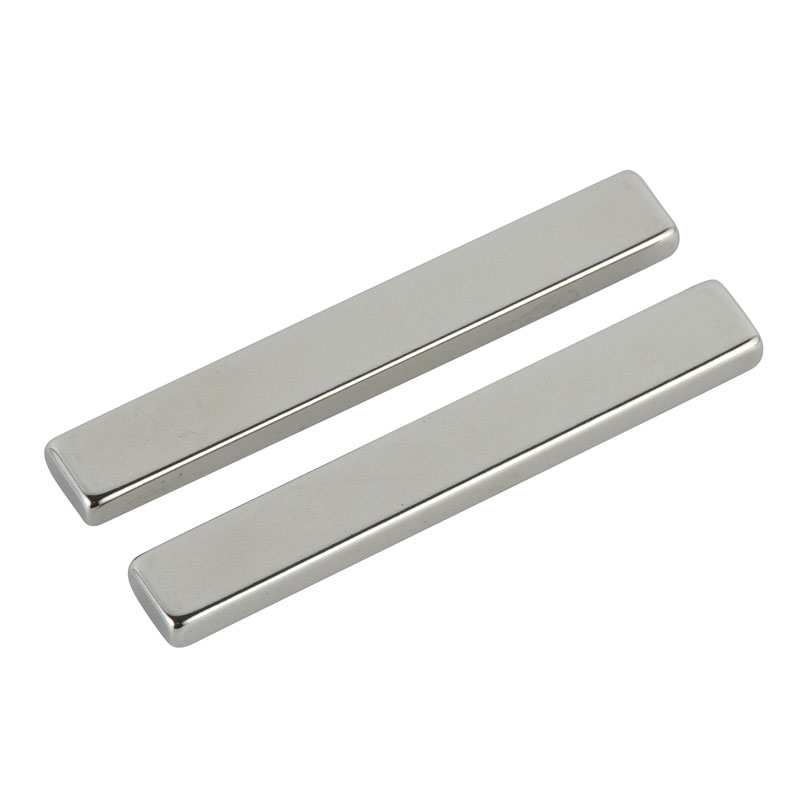 Custom Sintered NdFeB Magnets for Synchronous MotorsExplore custom sintered NdFeB rotor magnets for synchronous motors, offering high coercivity and thermal stability for EV traction, servo, and industrial drives.View Product →
What Happens When a Magnet Runs Past Its Limit
In most field failures the magnet never approaches its Curie point. It crosses the knee of the demagnetization curve at elevated temperature and keeps a permanent record of the event.
- Flux measured in a Helmholtz coil reads 2–15 % low after a heat soak and does not recover at room temperature.
- A second soak adds a smaller loss; after three or four cycles the value stabilizes, the signature of partial demagnetization rather than thermal damage.
- A part that genuinely passed Tc reads near zero and stays there, because the magnetization direction itself is gone.
Re-magnetization is possible when the coating, the geometry and any bonded or laminated assembly are intact. Thin arc segments and segmented rotor magnets are the exception: thermal expansion during a Curie-point excursion cracks them, and re-magnetization will not repair a crack.
The practical limits for sintered NdFeB are covered in more detail in this note on the working temperature of sintered NdFeB.
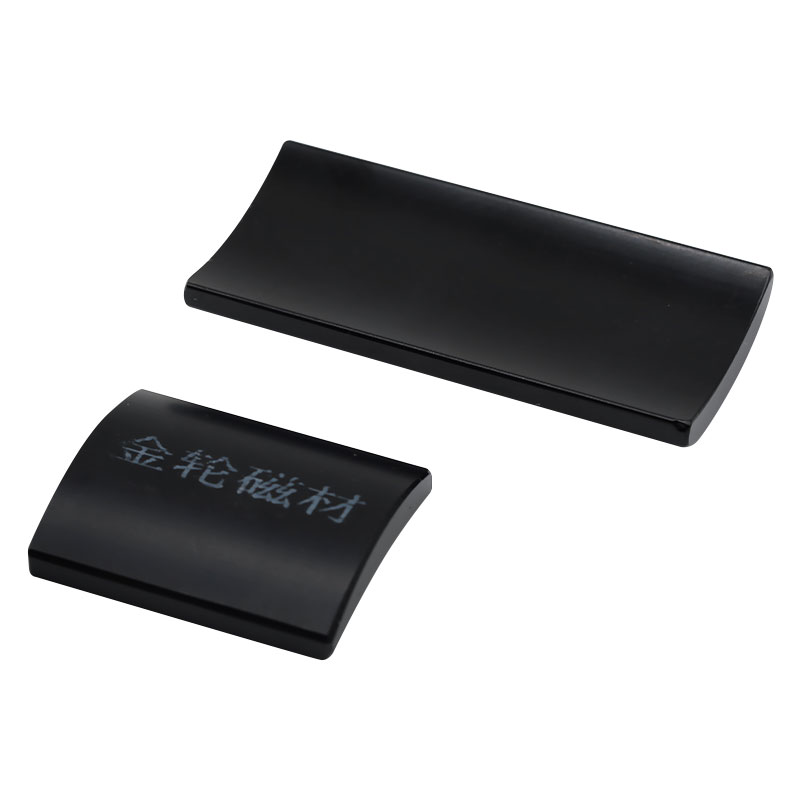 Custom Shape Sintered NdFeB Permanent MagnetsReview precision-machined sintered NdFeB magnets in discs, rings, blocks, and arcs for motors, generators, sensors, and actuators requiring stable high-density fields.View Product →
How to Specify a Magnet for a Hot Application
Work through this sequence. On a well-defined design it takes about an hour and usually prevents at least one redesign.
- Define magnet temperature, not ambient temperature. Add ambient, winding or coil rise, transient overload, and the offset between the sensor location and the magnet.
- Pick the grade by Hcj at temperature. Read the intrinsic demagnetization curve at the worst-case temperature, not at 20 °C.
- Sketch the load line. Estimate the permeance coefficient and confirm the operating point stays above the knee with margin.
- Budget the reversible loss. At −0.11 %/°C, remanence falls about 15 % between 20 °C and 150 °C, and torque follows.
- Check the mechanical side. Coating adhesion, adhesive selection and housing expansion must survive the same thermal cycle.
- Qualify with a heat soak. Soak at the rated maximum for one to two hours, cool to room temperature, measure flux, and repeat twice. Flat results mean a stable design.
- Move to SmCo only when the numbers justify it. Above roughly 250 °C, or where a near-flat torque curve matters, SmCo is often cheaper over the product lifetime than an oversized NdFeB design.
Demagnetization curves at temperature are the primary design document for this exercise; reference sets are available in the demagnetization curve reference.
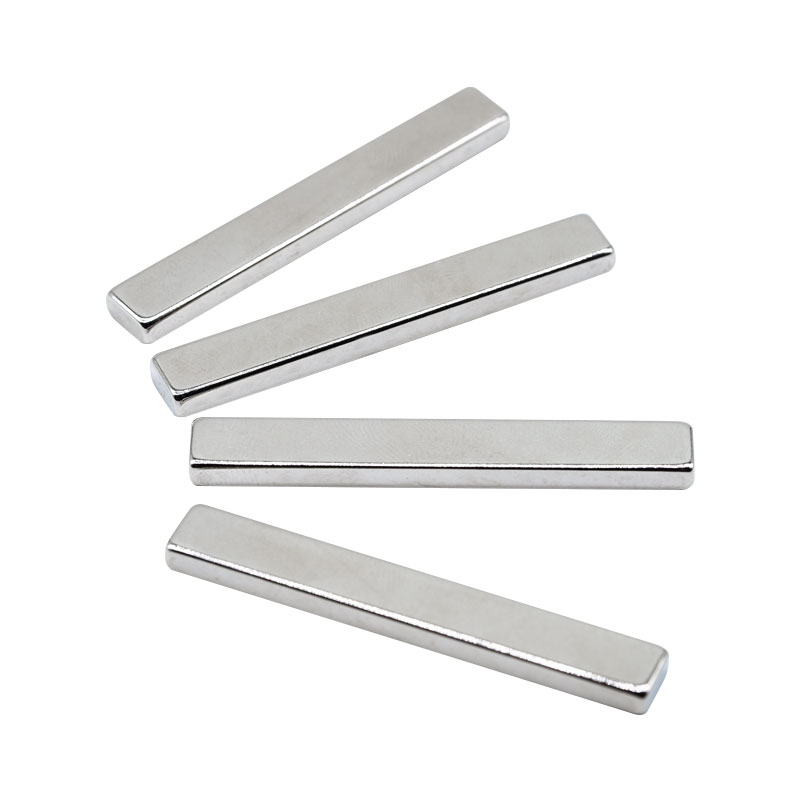 Sintered NdFeB Magnets for Automotive MotorsReview automotive sintered NdFeB magnets for traction, wiper, and windowlift motors; high coercivity and thermal stability support compact, torque-dense designs.View Product →
Frequently Asked Questions
At what temperature do neodymium magnets lose their magnetism?
Three thresholds apply. Reversible loss begins immediately at about −0.11 %/°C. Irreversible loss starts when the magnet exceeds its grade's maximum operating temperature, from 80 °C for an N grade up to roughly 230 °C for an AH grade. The Curie point, where magnetism disappears entirely, is 310–360 °C for sintered NdFeB.
Is the Curie point the same as the maximum operating temperature?
No, and the gap is wide. A UH-grade NdFeB magnet is rated for 180 °C service while its Curie point sits near 340 °C. Maximum operating temperature is a system rating reflecting coercivity, load line and geometry; the Curie point is intrinsic to the material.
Does a magnet recover after being heated past its Curie point?
The material becomes ferromagnetic again as it cools, but the magnetization does not return on its own. Domains reform in random orientations, so the part behaves as an unmagnetized magnet until it is re-magnetized in a strong external field.
Which permanent magnet has the highest Curie point?
Among common commercial materials, AlNiCo leads at roughly 800–860 °C, followed by SmCo at 700–800 °C. Sintered ferrite sits near 450 °C, and NdFeB is lowest at 310–360 °C.
The Curie point is the right place to start understanding how a magnet behaves when it gets hot, and the wrong place to stop. Treat it as the absolute ceiling of the material, then do the design work where it counts: the grade suffix, intrinsic coercivity at worst-case temperature, the load line, and a heat soak test that proves the design survives three cycles.
If you are evaluating grades for a high-temperature motor, generator or sensor application, our engineering team can support grade selection and sample evaluation against your thermal profile.