EN
 English
 中文简体
 русский
 Deutsch
 日本語
 한국어


A loudspeaker needs a magnet because the magnet supplies the fixed magnetic field that the voice coil pushes against. Audio current in the coil produces a force proportional to the current and to the flux density in the air gap (F = B·I·L), so remove the magnet and the coil still carries current but moves nothing, the diaphragm never disturbs the air, and the driver is silent.
Inside a working driver the magnet does four jobs at once:
- It fills the gap around the voice coil with a steady, evenly distributed flux, commonly 0.8–1.5 T in production designs.
- It sets the force factor Bl (tesla-metres, or newtons per ampere), which drives sensitivity and electrical damping.
- It often holds the magnetic circuit together; in many ferrite woofers the ceramic ring is a structural part clamped between the top plate and the bottom plate.
- It determines how much steel and copper the rest of the motor needs, because a stronger gap field reaches the same output with a shorter coil and a lighter assembly.
The notes below cover the mechanism, why permanent magnets replaced electromagnets, how ferrite and neodymium compare, and which magnet details belong on a purchase drawing.
How a speaker magnet converts current into sound
The magnet's role in the motor is narrow and absolute: it creates the steady field the coil must work against.
A moving-coil driver is a magnetic circuit with four visible parts:
- A permanent magnet, normally a ring or a disc, magnetised through its thickness.
- A top plate and a bottom plate (T-yoke) that steer flux into the gap.
- A centre pole that leaves a narrow annular gap, often 0.5–1.5 mm wide.
- A voice coil suspended in that gap and bonded to the diaphragm.
Flux travels from the magnet through the top plate, across the gap, into the pole piece and back through the bottom plate. Because the field direction is fixed, the current's polarity decides the direction of the force: positive current pushes the coil outward, negative current pulls it back. An alternating audio signal therefore produces alternating motion, and the diaphragm radiates that motion as sound.
Bl is where the magnet shows up in the datasheet. A 10-inch woofer typically sits around 10–15 T·m. Raise the gap flux by 10 percent and (Bl)²/Re climbs about 21 percent, which is roughly 0.8 dB of extra sensitivity and a lower Qes.
Why permanent magnets replaced field coils
Permanent magnets won on weight, cost and the fact that they need no supply current to keep the field alive.
Early mains radios used field-coil speakers: a DC winding on the iron circuit both excited the gap and doubled as a smoothing choke in the power supply. Once barium and strontium ferrite became cheap in the 1950s, a ceramic ring could do the same job with no winding, no heat and no hum. Field coils did have one advantage designers still miss: the gap flux could be trimmed electrically to tune Qts. With a permanent magnet that setting is frozen at build, which is why grade, dimensions and tolerances decide driver behaviour long before anyone touches the crossover.
Speaker magnet materials compared
Ferrite and sintered neodymium cover almost all loudspeaker production, while samarium cobalt and alnico survive in niches where heat or heritage outweighs cost.
| Material | Br (T) | Max energy product | Mass for the same gap flux | Cost per part | Practical thermal limit | Typical speaker use |
|---|---|---|---|---|---|---|
| Ferrite (ceramic) | 0.38–0.44 | 3.5–4.5 MGOe | 8–10 times neodymium | Lowest | About 250 °C, reversible loss only | Woofers, subwoofers, car audio, budget PA |
| Sintered NdFeB | 1.2–1.45 | 35–52 MGOe | Reference (1x) | Highest, price volatile | 80–200 °C depending on grade | Portable speakers, headphones, line arrays |
| Samarium cobalt | 0.9–1.1 | 16–32 MGOe | 2–3 times | High | 300 °C and above | High-temperature pro audio, marine, aerospace |
| Alnico | 0.6–1.3 | 5–10 MGOe | 4–6 times | Medium to high | 450 °C and above, but low coercivity | Vintage-style guitar speakers, some hi-fi |
Mass follows energy product. Neodymium stores roughly eight to ten times more energy per unit volume than ferrite, so an equivalent motor needs one-eighth to one-tenth of the magnet mass: a 15-inch ferrite woofer often carries 1–2 kg of ceramic ring, while the neodymium version sits near 150–300 g. That ratio, not a difference in tone, is the real reason neodymium reshaped portable and installed audio.
Why neodymium suits compact and pro audio designs
Neodymium is chosen when weight, depth or gap flux density is the binding constraint.
A line-array element, a headphone driver or a soundbar woofer has no room for a one-kilogram ceramic ring. An N42 or N45 grade can deliver the same Bl from a ring a few millimetres thick, allowing a shallower basket, a lighter cabinet and easier rigging. Higher gap flux also lets designers run a longer coil at the same sensitivity, trading efficiency for excursion without losing output.
The trade-offs are cost and heat. Standard N grades lose flux irreversibly above roughly 80 °C, so drivers with hot coils need H, SH or UH classes with higher intrinsic coercivity, sometimes made with grain-boundary dysprosium diffusion to keep both cost and flux density under control. This magnet family is the same one used in traction and servo drives; a note on NdFeB magnets in the motor industry covers the wider engineering picture.
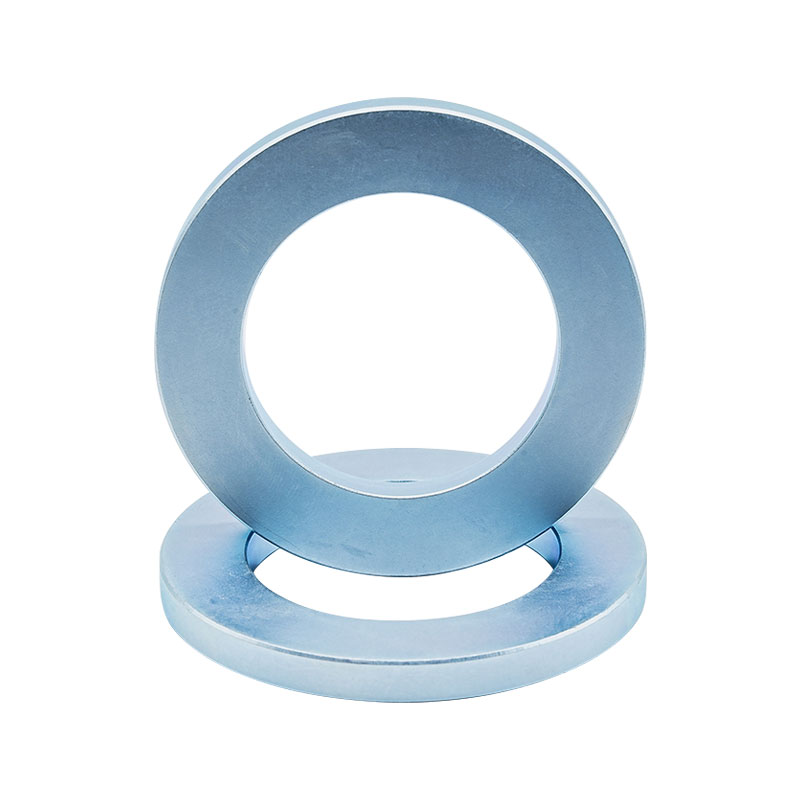 Ring Sintered NdFeB Magnets for Motor DrivesRing geometry delivers uniform flux and reduced leakage for servo, traction and generator systems; heavy rare-earth grades support higher-temperature operation.View Product →
When ferrite is still the better buy
Ferrite wins whenever the enclosure can carry the weight and the budget cannot.
A ceramic ring costs a fraction of a neodymium ring that produces comparable gap flux, and the raw materials are not exposed to rare-earth price swings. Ferrite also tolerates roughly 250 °C without irreversible loss and needs no coating, because the oxide is already inert — useful for outdoor, marine and industrial products. In subwoofers the extra mass frequently doubles as cabinet ballast. Where ferrite loses is bulk and stray field: the ring is large, flux spreads further, and shielding a compact powered speaker becomes harder.
Matching the magnet format to the speaker type
The magnet shape follows the motor topology, not personal preference.
- Ring magnets: the default for conventional moving-coil motors, sitting between the plates around the pole.
- Disc magnets: common in tweeters, headphone drivers and compact full-range units built on a pot-type motor.
- Arc and trapezoid segments: used where the circuit wraps a larger bore or a segmented stack is easier to press.
- Custom geometries: cut or pressed around a non-standard gap, a sensor pocket or a mounting feature.
Whichever format is chosen, the drawing should fix the magnetised axis, because a few degrees of skew is invisible on paper and audible in distortion.
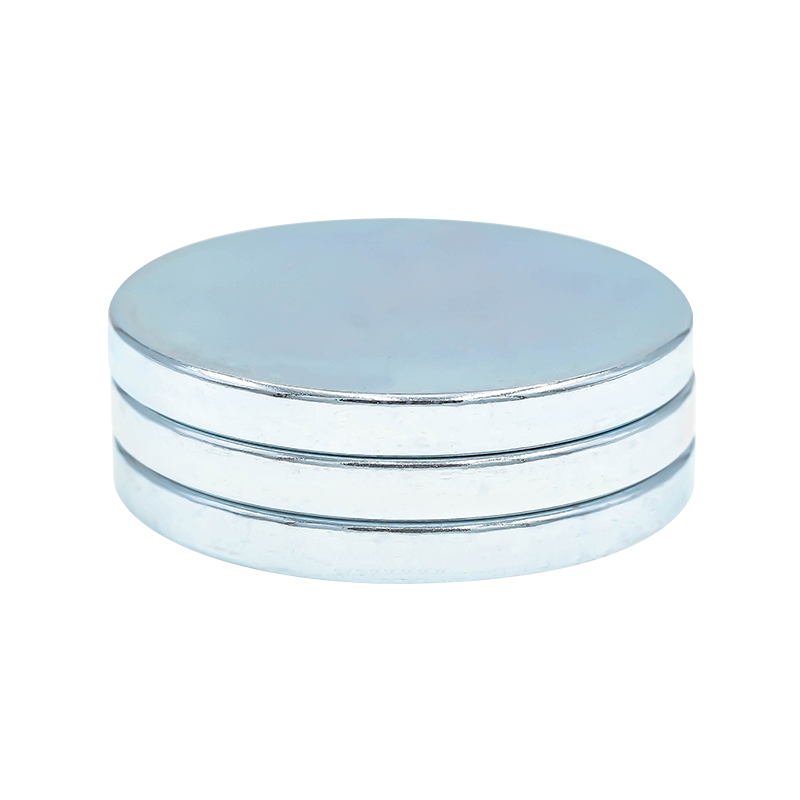 Disc Permanent Magnets for Compact Magnetic AssembliesCircular magnets with uniform field distribution suit compact motor, sensor and encoder designs; material and coating options address heat, corrosion and dimensional requirements.View Product →
Design and sourcing risks that actually bite
Most speaker magnet problems trace back to heat, corrosion or dimensional drift rather than to the material itself.
- Thermal demagnetization. Validate the demagnetization curve at the maximum voice-coil temperature, not Br at 20 °C; pro audio coils can reach 150–200 °C on peaks.
- Corrosion. NiCuNi coatings of 10–20 micrometres are standard, while humid, coastal or outdoor products usually need epoxy or a double layer plus a stated salt-spray duration.
- Dimensional drift. Gap concentricity depends on ring inside and outside diameter to about 0.05 mm and ground thickness to about 0.02 mm; a few hundredths out appears as rub, buzz or Bl scatter.
- Loose particles and chipping. One flake in a 0.8 mm gap will score the coil former.
- Lot-to-lot Bl spread. A supplier holding ±3 percent keeps sensitivity within about 0.2 dB; wider spread forces gain trimming on the line.
What to put on a magnet specification
A speaker magnet drawing should state the properties that move acoustics, not only the geometry.
| Specification item | Example target | Why it matters |
|---|---|---|
| Grade and coercivity class | N42SH class with high Hcj | Keeps flux after sustained coil heat |
| Ring dimensions | ID and OD within 0.05 mm, ground thickness within 0.02 mm | Gap concentricity and repeatable Bl |
| Coating | NiCuNi 10–20 micrometres, salt spray 48–96 hours | Corrosion resistance in humid use |
| Magnetization | Axial, skew within 5 degrees | Symmetric force on the coil |
| Thermal validation | Demag curve knee above maximum coil temperature | Prevents irreversible flux loss |
| Lot consistency | Bl within ±3 percent | Stable sensitivity and Qts across production |
| Mechanical limits | Chip limits defined, no loose burrs | Clean gap, no coil rub |
Suppliers who publish demagnetization curves and physical property data shorten this conversation considerably. Our sintered NdFeB magnet range covers ring, disc, arc and trapezoid formats with surface treatment options, and non-standard gaps are usually handled as a drawing-based item.
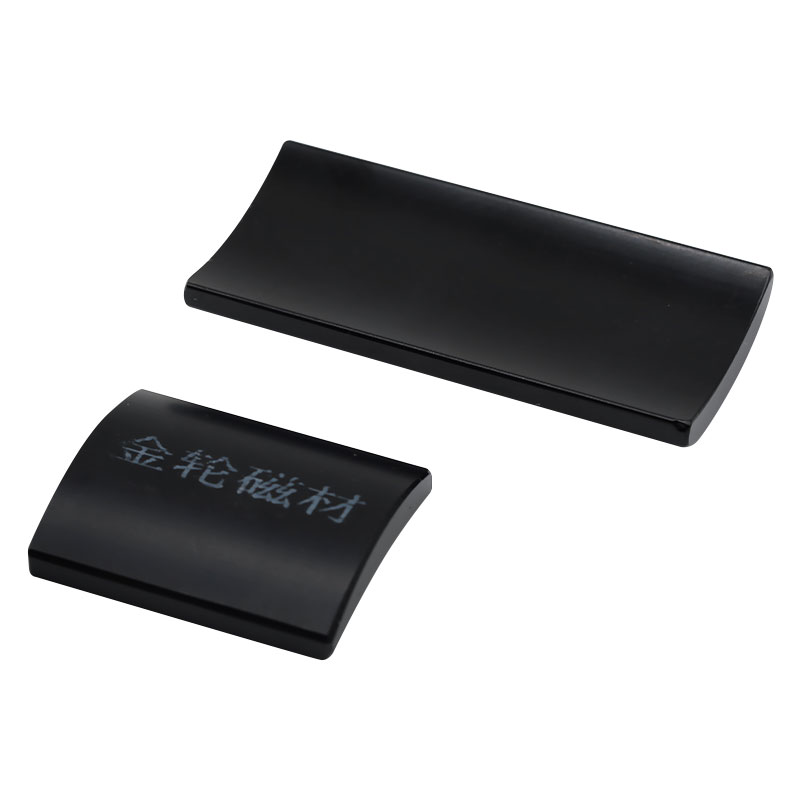 Custom Shape Sintered NdFeB MagnetsPrecision-machined custom geometries and magnetization options address non-standard gaps in motors, sensors and precision actuators, with high energy density and dimensional accuracy.View Product →
Frequently asked questions
Do all speakers have magnets?
Every moving-coil speaker does. Piezoelectric, electrostatic and plasma tweeters are the exceptions: they move a diaphragm with a charge or a piezoelectric element instead of a magnetic motor, so they contain no permanent magnet.
Can a speaker magnet lose its strength?
Yes, but not through normal listening. Flux drops irreversibly when the magnet is overheated beyond its grade limit, exposed to a strong opposing field, or mechanically shocked. A correctly specified magnet kept inside its thermal rating typically loses only a fraction of a percent over many years.
Does a bigger magnet mean better bass?
No. A bigger magnet raises Bl, which lifts sensitivity and lowers Qes, giving the amplifier more control over the cone. Bass extension is set by suspension compliance, moving mass and the enclosure, so a large magnet in the wrong alignment can still produce a thin-sounding woofer.
Do neodymium speakers sound different from ferrite ones?
Not because of the material. Any audible difference comes from the motor built around it: gap flux, coil length, Qes and box alignment. Two drivers with the same Bl, the same cone and the same enclosure behave alike in the passband, whatever magnet sits in the gap.
Why are some speaker magnets so heavy?
Because ferrite stores far less energy per unit volume. Reaching a useful gap flux requires a large ceramic ring, and that mass is often bolted straight to the baffle of subwoofers and PA boxes, where it also helps stabilise the cabinet.
The short answer to why speakers have magnets is that a current-carrying coil needs a fixed field to react against, and a permanent magnet provides that field with no wires, no supply current and no heat. Everything after that — ferrite or neodymium, ring or disc, which coercivity class, which tolerance — is a trade between cost, weight, thermal margin and manufacturability. Settle those points on the drawing and most acoustic problems never reach the first prototype.