 EN
 English
 中文简体
 русский
 Deutsch
 日本語
 한국어


Home / News / Industry News / Alinco Magnet Explained: Alnico Grades, Properties and NdFeB Alternatives
Industry News
Nov 16,2026
Alinco Magnet Explained: Alnico Grades, Properties and NdFeB Alternatives
An Alinco magnet is an Alnico magnet: a cast or sintered alloy of aluminium, nickel, cobalt and iron that stores roughly 1.3 to 5.5 MGOe of energy and keeps working at 450 °C and above. "Alinco" is simply a common spelling variant of Alnico, so the grades, tolerances and selection rules below apply to the same material family.
That distinction matters in one very specific situation: when a magnetic circuit fails not because the magnet is too weak, but because it runs too hot. A sintered NdFeB grade can shed 12 percent or more of its flux at 150 °C; a well-chosen Alnico grade loses around 3 percent over the same rise and returns to its original output once it cools. If your design brief says "hot, stable, low drift", Alnico deserves a look before you add dysprosium to an NdFeB grade.
What the "Alinco" Spelling Actually Refers To
Alnico is a precipitation-hardened alloy whose name is a contraction of its main elements: aluminium, nickel and cobalt, with iron as the balance. A typical chemistry runs 6–12% aluminium, 14–28% nickel, 5–24% cobalt, up to 6% copper and up to 8% titanium, and it is the heat treatment rather than the recipe alone that develops the magnetic properties.
Two production routes dominate, and they behave differently in a purchasing conversation:
- Cast Alnico. Large cross-sections, complex cast shapes and integrated pole pieces are possible, but dimensional tolerances are loose — often ±0.5 mm or worse on as-cast faces — and internal porosity can vary between lots.
- Sintered Alnico. Smaller parts, tighter as-sintered dimensions and better batch repeatability, which is why sensor housings and small instrument magnets are usually sintered rather than cast.
Neither route gives you a material you can machine freely. Both are hard and brittle, so diamond grinding is the normal finishing operation, and grinding cost frequently exceeds the blank cost on small parts.
Alnico Grades at a Glance
For most industrial sourcing the choice narrows quickly: Alnico 5 when you need the highest flux from a given area, Alnico 8 when resistance to demagnetization matters more than raw strength.
| Grade | Typical Br | Typical Hcj | Max energy product | Typical use |
|---|---|---|---|---|
| Alnico 2 | 0.70–0.75 T | 40–45 kA/m | ~13 kJ/m³ | Vintage-style pickups, reed switches |
| Alnico 5 | 1.20–1.28 T | 48–52 kA/m | ~40 kJ/m³ | Speakers, sensors, general instrumentation |
| Alnico 6 | ~1.05 T | ~60 kA/m | ~28 kJ/m³ | Compromise grade for moderate fields |
| Alnico 8 | 0.80–0.82 T | 140–160 kA/m | ~40 kJ/m³ | Open-circuit designs, higher demagnetization margin |
| Alnico 9 | ~1.05 T | ~120 kA/m | ~72–76 kJ/m³ | Columnar-crystal parts where size is critical |
The pattern is easy to misread: raising coercivity in Alnico usually costs you Br. Alnico 8 holds its flux far better in an open magnetic circuit than Alnico 5, but it starts from a lower flux level, so the two are not interchangeable without re-checking the circuit.
Where Alnico Still Beats Sintered NdFeB
Alnico wins on stability and temperature headroom, not on strength. Three numbers explain almost every design decision:
- Reversible temperature coefficient of Br. Around −0.02%/°C for Alnico 5, against roughly −0.11%/°C for standard sintered NdFeB grades. Across a −50 to +150 °C duty cycle, that is the difference between a sensor that stays calibrated and one that needs compensation circuitry.
- Curie temperature. Alnico sits in the 740–860 °C range; sintered NdFeB is in the 310–350 °C range. Above about 230 °C, most NdFeB grades are out of scope entirely.
- Corrosion behaviour. Alnico parts are normally used bare. Sintered NdFeB needs nickel-copper-nickel plating, epoxy or another barrier coating, and any coating damage becomes a long-term reliability question in humid or salt-spray environments.
There is a fourth, less obvious advantage: Alnico can be magnetized after assembly in many fixture designs, and it can be brazed or bonded into steel structures because it tolerates the heat involved.
Where Alnico Loses — and the Mistakes That Cost Money
Alnico's limiting factor is coercivity, not flux density, and that single fact drives most field failures. Its Hcj of 40–160 kA/m is an order of magnitude below a conventional sintered NdFeB grade, so the material is easy to demagnetize partially — by an opposing field, by an adjacent magnet, or even by its own geometry.
- Self-demagnetization. A short Alnico part magnetized through its thickness will demagnetize itself. As a working rule, keep the length along the magnetization axis at least half the diameter, and preferably equal to it.
- Storage and handling. Unmagnetized parts are safe, but magnetized Alnico should be stored with soft-iron keepers bridging the poles, otherwise the working point drifts downward permanently.
- Magnetizing field. Because Hcj is low, fixturing is simple, but under-magnetizing is common when a fixture built for ferrite is reused. Verify flux after assembly, not before.
- Volume penalty. Replacing NdFeB with Alnico typically requires five to ten times the magnet volume for the same air-gap flux, which usually kills the idea in weight-sensitive products.
| Property | Alnico (cast or sintered) | Sintered NdFeB |
|---|---|---|
| Br | 0.6–1.4 T | 1.2–1.45 T |
| Max energy product | 10–76 kJ/m³ | 240–420 kJ/m³ |
| Hcj | 40–160 kA/m | 800–2,400 kA/m |
| Max service temperature | 450–520 °C | 80–230 °C by grade |
| Br temperature coefficient | ≈ −0.02%/°C | ≈ −0.11%/°C |
| Coating required | No | Yes (NiCuNi, epoxy, others) |
| Machining | Grinding only | Grinding, limited cutting |
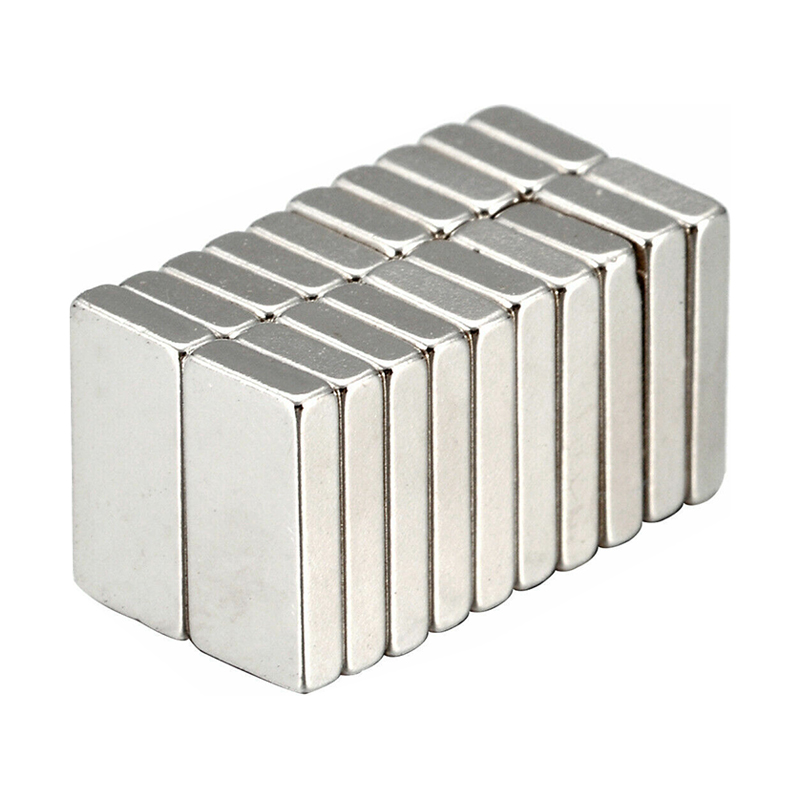 Block Sintered NdFeB ManufacturersBlock Sintered NdFeB is a rectangular neodymium–iron–boron magnet produced through powder metallurgy sintering. This product category shares common characteristics suc...View Product →
In practice, the comparison table ends the debate for motor rotors and begins it for high-temperature sensors, metering devices and loudspeaker motors.
Choosing Between Alnico and Sintered NdFeB
Decide on operating temperature and demagnetization margin first; size and cost follow from that answer. A short checklist keeps the process honest:
- Map the real temperature at the magnet surface, not at the housing. A 40 °C error here is common and changes the material choice.
- Estimate the worst-case demagnetizing field — inrush current, adjacent coil, reverse assembly — and compare it to the intrinsic curve with margin.
- Check the permeance of the actual geometry, including any steel return path, rather than trusting a datasheet value measured on a closed circuit.
- Only then compare cost per unit of delivered flux, including grinding, coating and magnetizing fixture cost.
Where the answer points to a rotating machine, motor-grade synchronous motor magnet assemblies are usually specified with a high-coercivity NdFeB grade and a defined maximum operating temperature, because torque density dominates the design. Where the answer is a hot sensor or a legacy replacement part, Alnico remains the lower-risk route.
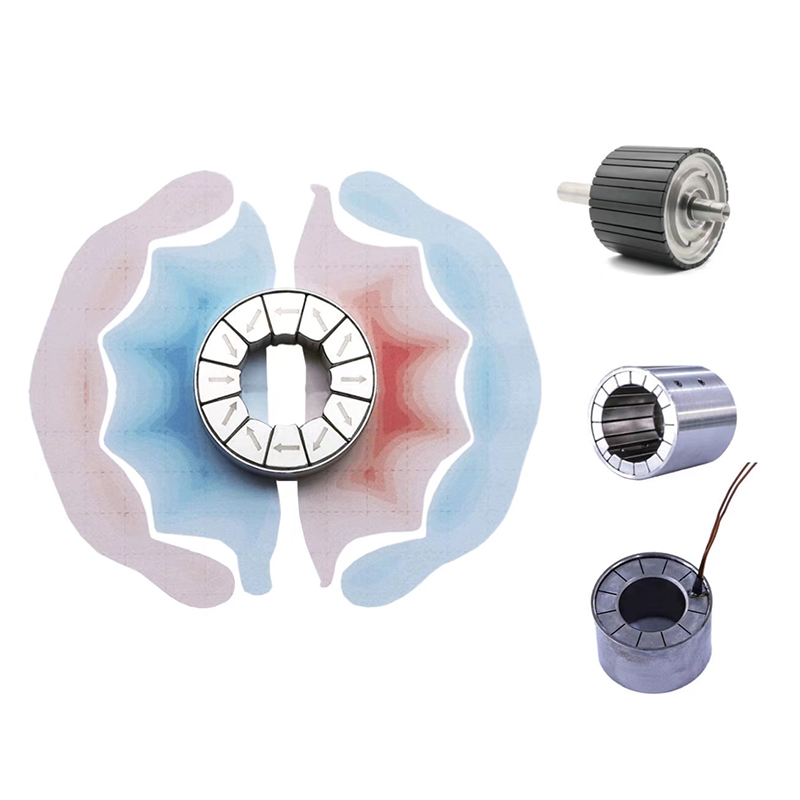 Custom Halbach Magnet Assemblies for Compact Motor SystemsCustom Halbach assemblies concentrate working-side flux and reduce leakage using arranged NdFeB magnets; review magnetization angles and tolerances for motor or sensor designs.View Product →
Specifying, Magnetizing and Protecting the Part
Tolerances and finishing are where Alnico and NdFeB projects diverge most in cost, so put both on the drawing before requesting quotations. Practical points that come up repeatedly:
- Dimensions. Sintered Alnico is realistic at ±0.05 mm on ground faces and about ±0.1 mm as-sintered; cast Alnico should be quoted with machining allowance.
- Magnetic tolerances. Specify a flux or moment window per part rather than a Br value, since Br cannot be verified on a finished component.
- Surface. Alnico is generally supplied bare or with a light passivation; NdFeB normally needs a barrier coating, and the choice of surface treatment affects both salt-spray life and dimensional stack-up.
- Assembly. Parts that will be glued or press-fitted should be magnetized at the latest possible stage, and sintered NdFeB should never be dropped onto a steel bench where chips can lodge.
For automotive programmes, the magnet specification usually also fixes a maximum working temperature, a coating class and a lot-traceability requirement, which is why automotive-field magnet supply conversations tend to start with the drawing and the test plan rather than with the grade name.
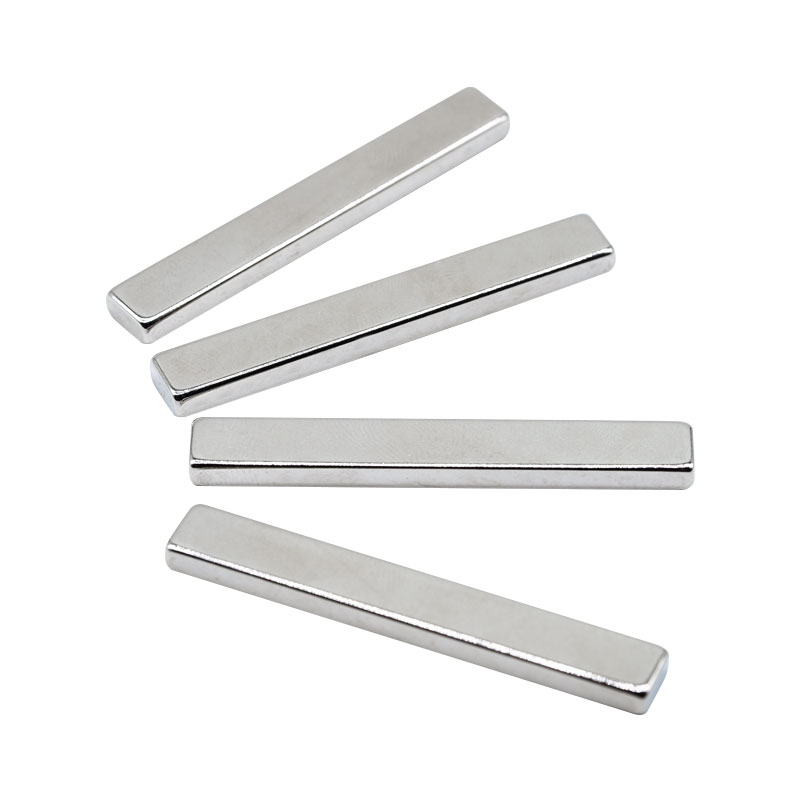 Sintered NdFeB Magnets for Automotive ApplicationsCustom sintered NdFeB magnets for automotive motors, actuators and sensors offer high magnetic strength and precision; specify grade, coating and traceability with the drawing.View Product →
Frequently Asked Questions
Is an "alinco magnet" a real product name?
No. It is a spelling variant of Alnico, the aluminium-nickel-cobalt family. Any quotation for an "alinco magnet" should come back naming a specific grade such as Alnico 5 or Alnico 8, because the grade determines performance far more than the family name does.
Can Alnico simply replace NdFeB in an existing design?
Rarely without a redesign. Expect five to ten times the magnet volume for the same air-gap flux, plus a different demagnetization margin. It is a workable swap when the NdFeB part is failing on temperature or coating life, and usually a poor swap when the constraint is weight or package size.
How hot can an Alnico magnet run?
Common grades remain usable to roughly 450 °C, and some to about 520 °C, with the limit set by the grade and by how much flux loss the circuit can tolerate. That headroom, not the energy product, is the reason Alnico still appears in aerospace, metering and industrial sensor designs.
Do Alnico magnets need a protective coating?
Usually not. Alnico resists corrosion well enough to be used bare in most indoor applications, although iron-rich grades can show light surface rust in humid storage, and a thin protective finish is sensible where condensation is expected.
Why do Alnico magnets come with keepers?
Because low coercivity means the material can be partially demagnetized by its own stray field. A soft-iron keeper across the poles raises the permeance of the circuit, holds the working point steady during shipping and storage, and is removed only at the point of assembly.
Treat "alinco magnet" as a search term, not a specification. The material behind it is Alnico — stable, hot-capable, corrosion-tolerant and comparatively weak — and it earns its place in designs where drift and temperature matter more than compactness. For everything else, a sintered NdFeB grade with a properly matched coating and a verified demagnetization margin remains the more efficient answer.

Jinlun Magnet specialized in the research and development, production, and sales of high-performance rare-earth permanent magnet materials.
Quick Links
Contact Info.
-
 Sales00@jlmagnet.com
-
 +86-574-6321 2222
-
 No. 330 Xinxing 1st Road, Xinxing Industrial Park, Zonghan Street, Cixi City, Zhejiang Province, China
Mobile QR Code
Copyright © Ningbo Jinlun Magnet Technology Co., Ltd. All Rights Reserved.
China sintered NdFeB magnet manufacturer wholesale sintered NdFeB magnet factory

TOP

