 EN
EN English
 中文简体
中文简体 русский
 Deutsch
 日本語
日本語 한국어
한국어

Industry News
Apr 02,2026
What's the Strongest Magnet?
Quick Answer: The strongest permanent magnet available today is the neodymium magnet (NdFeB), capable of producing magnetic fields up to about 1.4–1.6 Tesla at its surface. For laboratory and scientific use, superconducting electromagnets hold the record — reaching beyond 45 Tesla in continuous-field experiments and over 100 Tesla in brief pulsed fields.
Magnets are everywhere — in your phone's speakers, electric vehicle motors, MRI machines, and industrial equipment. But not all magnets are created equal. The question "what's the strongest magnet" has two answers depending on what you mean: the strongest everyday permanent magnet, or the most powerful magnet ever created by science. This guide explores both, with clear comparisons and practical context.
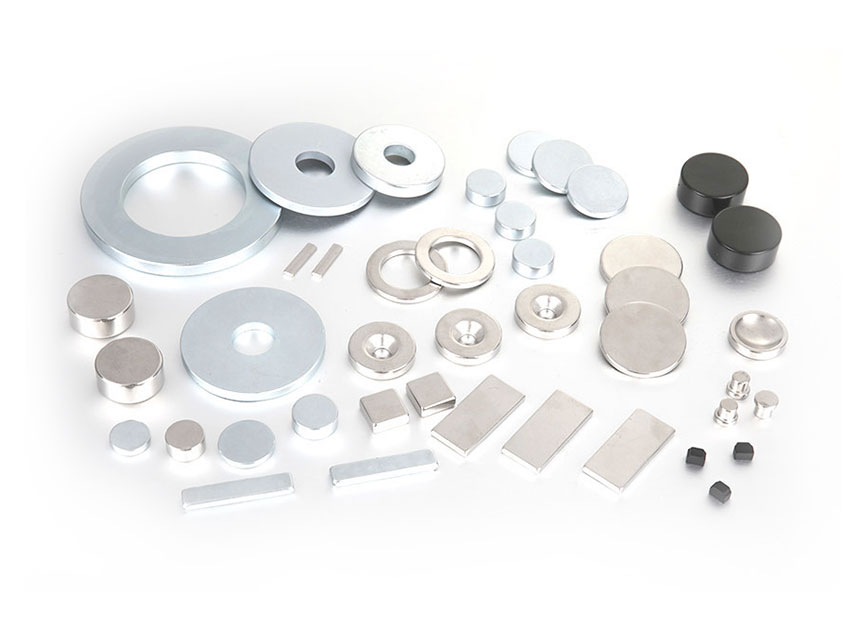
Click to visit our products:Sintered NdFeB Magnet
How Is Magnet Strength Measured?
Before comparing magnets, it helps to understand the units used to describe magnetic strength:
| Unit | What It Measures | Common Context |
| Tesla (T) | Magnetic flux density | MRI machines, research labs |
| Gauss (G) | Magnetic flux density (smaller unit) | Consumer products, fridge magnets |
| BHmax (MGOe) | Maximum energy product (magnet efficiency) | Comparing permanent magnets |
| Pull Force (lbs/kg) | Physical holding strength | Industrial & everyday use |
1 Tesla = 10,000 Gauss. A standard refrigerator magnet measures roughly 0.001 Tesla (10 Gauss), while a neodymium magnet may reach 1.4 Tesla or more at its surface.
The Strongest Permanent Magnet: Neodymium (NdFeB)
When people ask "what is the strongest magnet" in everyday terms, the answer is consistently the neodymium magnet, also known as a rare earth magnet. Composed of an alloy of neodymium, iron, and boron (Nd₂Fe₁₄B), it was developed in the early 1980s and remains the most powerful permanent magnet material known.
Key Properties of Neodymium Magnets
- Maximum energy product (BHmax): Up to 52 MGOe — the highest of any permanent magnet
- Surface field: 1.0 – 1.6 Tesla depending on grade
- Coercivity: High resistance to demagnetization
- Temperature sensitivity: Loses strength above ~80°C (176°F) unless specially treated
- Common grades: N35 through N52 (higher number = stronger magnet)
- Weight-to-strength ratio: Exceptionally high — a small cube can lift hundreds of times its own weight
Did You Know? A neodymium magnet the size of a golf ball can generate a pull force of over 100 kg (220 lbs). Industrial-grade versions used in wind turbines and EV motors can produce even greater forces.
Permanent Magnet Strength Comparison
Not all permanent magnets are equal. Here's how the most common types stack up:
| Magnet Type | BHmax (MGOe) | Max Surface Field | Temp. Resistance | Cost |
| Neodymium (NdFeB) | 35 – 52 | ~1.0 – 1.6 T | Low (80–200°C) | Medium–High |
| Samarium Cobalt (SmCo) | 16 – 32 | ~0.8 – 1.1 T | High (up to 350°C) | High |
| Alnico | 5 – 9 | ~0.6 – 1.3 T | Very High (540°C) | Medium |
| Ceramic / Ferrite | 1 – 4 | ~0.2 – 0.4 T | Medium (250°C) | Low |
| Flexible Magnet | <1 | <0.1 T | Low | Very Low |
Neodymium magnets win on raw strength, but samarium cobalt magnets are preferred in high-temperature environments such as jet engines or downhole drilling equipment, where neodymium magnets would lose their magnetism.
The World's Strongest Magnets: Superconducting Electromagnets
Beyond permanent magnets, electromagnets — and specifically superconducting electromagnets — are far more powerful. These require a continuous flow of electricity and are not "permanent," but they dwarf any rare earth magnet in field strength.
Record-Breaking Magnetic Fields
- Continuous magnetic field record: 45.5 Tesla — achieved at the National High Magnetic Field Laboratory (MagLab) in Florida, USA, using a hybrid resistive-superconducting magnet system.
- Pulsed (non-destructive) field record: Over 100 Tesla — produced in millisecond bursts for scientific experiments.
- Destructive pulsed field record: Approximately 2,800 Tesla — created in a single-shot experiment in which the equipment itself is destroyed by the field.
- MRI magnets: Clinical MRI machines typically operate at 1.5 T or 3 T; research MRI systems reach 7 T or higher.
How Superconducting Magnets Work
Superconducting magnets use coils of wire cooled to near absolute zero (typically using liquid helium at –269°C / –452°F). At these temperatures, certain materials lose all electrical resistance, allowing enormous currents to flow without energy loss — generating extremely powerful and stable magnetic fields. They are essential in particle accelerators, fusion reactors, and advanced MRI scanners.
Strongest Magnet by Category: Quick Reference
| Category | Winner | Strength | Use Case |
| Strongest permanent magnet | Neodymium (N52 grade) | ~1.6 T surface | EVs, speakers, tools |
| Strongest continuous-field magnet | Hybrid superconducting magnet | 45.5 T | Scientific research |
| Strongest pulsed magnet (non-destructive) | Pulsed electromagnet | >100 T | Physics experiments |
| Strongest medical magnet (MRI) | Research MRI system | Up to 11.7 T | Human brain imaging |
| Strongest natural magnet | Magnetite (lodestone) | ~0.1 T | Historical compasses |
Real-World Applications of the Strongest Magnets
Neodymium Magnets in Everyday Technology
- Electric vehicle motors: High-performance NdFeB magnets are critical in brushless DC motors for EVs.
- Wind turbines: Direct-drive generators rely on powerful permanent magnets to eliminate gearboxes.
- Consumer electronics: Headphones, speakers, hard drives, and phone vibration motors all use neodymium.
- Medical devices: MRI-compatible surgical tools and implantable devices use carefully controlled magnetic components.
- Industrial lifting: Magnetic cranes and lifting systems use large neodymium assemblies to handle steel plates and scrap metal.
Superconducting Magnets in Science
- Particle accelerators (e.g., the LHC): Thousands of superconducting dipole magnets guide proton beams around 27-km rings.
- Fusion energy research: Projects use superconducting magnets to confine superheated plasma.
- MRI scanners: Hospitals use superconducting coils to achieve the stable, homogeneous fields required for body imaging.
- Maglev trains: Superconducting magnets provide the levitation and propulsion in high-speed rail systems.
Safety Considerations with Strong Magnets
The power of strong magnets — especially large neodymium magnets — comes with real safety risks:
- Pinch injuries: Two large NdFeB magnets can snap together with enough force to crush fingers between them.
- Projectile hazard: Ferromagnetic objects (tools, cutlery) can fly toward powerful magnets at speed.
- Electronic interference: Strong magnets can damage credit cards, pacemakers, hearing aids, and electronic devices.
- Ingestion risk: Small magnets (especially multiple pieces) can cause serious internal injuries if swallowed — a concern particularly with children.
- Fragility: Neodymium magnets are brittle and can shatter when they collide, sending sharp fragments flying.
Safety Reminder: Always handle large neodymium magnets with protective gloves and eye protection. Keep them away from children, electronic medical implants, and sensitive electronic equipment.
Neodymium Grade Comparison: N35 vs N52
Neodymium magnets come in grades from N35 to N52. Higher grades mean greater magnetic strength:
| Grade | BHmax (MGOe) | Residual Flux (Br) | Typical Use |
| N35 | 33–36 | 11.7–12.2 kG | Craft projects, educational kits |
| N42 | 40–43 | 13.2–13.8 kG | General industrial, audio |
| N48 | 46–49 | 13.8–14.5 kG | Motors, actuators, sensors |
| N52 | 50–53 | 14.3–14.8 kG | High-performance EVs, aerospace, research |
Frequently Asked Questions (FAQ)
Q: What is the strongest magnet you can buy?
The strongest commercially available permanent magnets are Grade N52 neodymium magnets. These are available in various sizes and shapes — from small discs to large blocks — and are sold for industrial, scientific, and hobbyist use.
Q: Is a neodymium magnet stronger than an electromagnet?
For portable, self-contained use, yes — neodymium magnets are the strongest option. However, superconducting electromagnets can generate fields many times stronger when powered, making them far superior in absolute strength but impractical for most everyday applications.
Q: What is the strongest natural magnet?
Magnetite (Fe₃O₄), commonly known as lodestone, is the strongest naturally occurring magnetic material. It was historically used in primitive compasses but is far weaker than modern engineered magnets.
Q: Can a magnet be too strong to be useful?
Yes. Extremely powerful magnets can attract nearby metal objects dangerously, interfere with electronics and medical devices, and are difficult to separate once brought together. In scientific settings, fields above certain thresholds also require special shielding for safe human operation.
Q: Do stronger magnets always have greater pull force?
Not always — pull force depends on both the magnet's grade and its size. A larger N42 magnet may have more pull force than a tiny N52 one. Grade determines material efficiency; size determines the total field energy available.
Q: Do neodymium magnets lose strength over time?
Under normal conditions, neodymium magnets are extremely stable and lose less than 1% of their magnetism per century. However, they can be demagnetized by exposure to excessive heat (above their Curie temperature), strong opposing magnetic fields, or physical shock.
Q: What's stronger — a neodymium magnet or a samarium cobalt magnet?
In terms of raw magnetic strength, neodymium magnets are stronger. But samarium cobalt magnets outperform neodymium in high-temperature environments and offer superior corrosion resistance, making them the preferred choice in demanding industrial applications.
Conclusion: What Is the Strongest Magnet?
The answer depends on your context:
- For everyday use, the neodymium magnet (Grade N52) is the strongest permanent magnet available, offering extraordinary field strength in a compact, affordable form.
- For industrial or high-temperature environments, samarium cobalt magnets offer a compelling trade-off between strength and stability.
- For scientific and engineering extremes, superconducting electromagnets far surpass any permanent magnet — reaching fields of 45 Tesla or more under controlled conditions.
Understanding what makes a magnet "strongest" — whether by surface field, pull force, energy density, or temperature performance — is key to choosing the right magnet for your application. As materials science advances, the ceiling for magnetic field strength continues to rise.

Jinlun Magnet specialized in the research and development, production, and sales of high-performance rare-earth permanent magnet materials.
Quick Links
Contact Info.
-
 Sales00@jlmagnet.com
-
 +86-574-6321 2222
-
 No. 330 Xinxing 1st Road, Xinxing Industrial Park, Zonghan Street, Cixi City, Zhejiang Province, China
Mobile QR Code
Copyright © Ningbo Jinlun Magnet Technology Co., Ltd. All Rights Reserved.
China sintered NdFeB magnet manufacturer wholesale sintered NdFeB magnet factory

TOP

