 EN
EN English
 中文简体
中文简体 русский
 Deutsch
 日本語
日本語 한국어
한국어

Home / News / Industry News / What Is NdFeB Magnets? The Complete Guide to Neodymium Iron Boron Magnets
Industry News
Mar 12,2026
What Is NdFeB Magnets? The Complete Guide to Neodymium Iron Boron Magnets
Quick Answer: NdFeB magnets (also called neodymium iron boron magnets or neodymium magnets) are a type of rare-earth permanent magnet composed of an alloy of neodymium (Nd), iron (Fe), and boron (B). First developed in the early 1980s, they are the strongest commercially available permanent magnets in the world, offering an extraordinary combination of high magnetic energy density, coercivity, and remanence in a compact size.
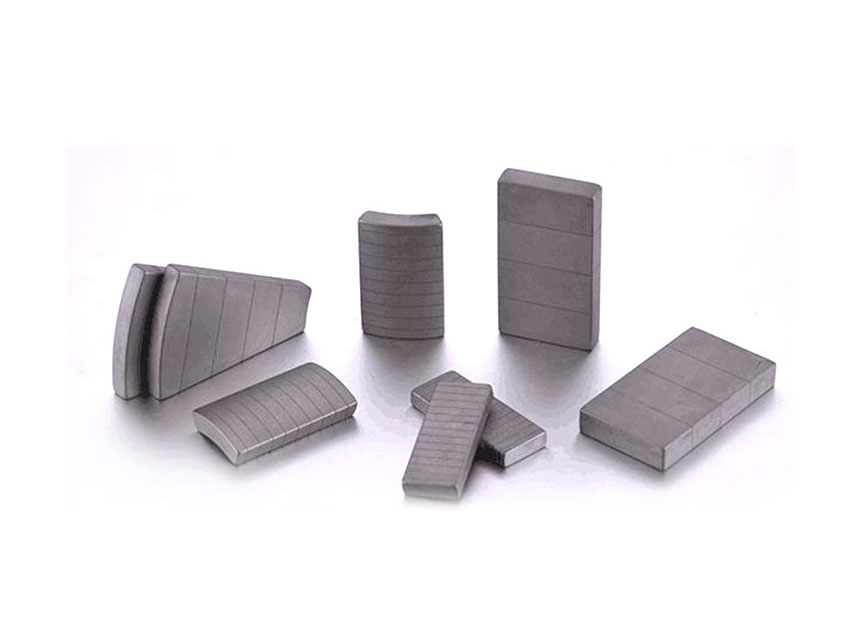
Click to visit our products:Sintered NdFeB Magnet
1. What Are NdFeB Magnets Made Of?
The chemical formula for the primary magnetic phase in an NdFeB magnet is Nd₂Fe₁₄B — a tetragonal crystalline structure that gives the material its exceptional magnetic properties. This intermetallic compound was independently discovered by General Motors and Sumitomo Special Metals in 1982–1984.
The alloy typically consists of approximately:
- Neodymium (Nd): 29–32% by weight — provides the anisotropic crystal field that drives high coercivity
- Iron (Fe): 64–68% by weight — the primary source of magnetic moment and high saturation magnetization
- Boron (B): ~1% by weight — stabilizes the crystal structure and raises Curie temperature
- Additional elements (Dy, Tb, Co, Al, Cu, Nb): added in small quantities to improve temperature stability, corrosion resistance, and coercivity
The addition of heavy rare-earth elements like dysprosium (Dy) or terbium (Tb) is common in high-temperature grades to maintain performance above 150°C.
2. Key Magnetic Properties of NdFeB Magnets
The outstanding performance of neodymium iron boron magnets comes from a unique set of measurable magnetic parameters. Understanding these properties is essential when selecting the right grade for your application.
| Property | Symbol | Typical Range (NdFeB) | What It Means |
| Remanence | Br | 1.0 – 1.5 T | Residual magnetic flux density after magnetization |
| Coercivity | Hcj | 955 – 3,000+ kA/m | Resistance to demagnetization |
| Max Energy Product | (BH)max | 200 – 470 kJ/m³ | Overall "strength" of the magnet per unit volume |
| Curie Temperature | Tc | 310 – 380°C | Temperature above which magnetism is lost |
| Max Operating Temp. | Tmax | 80 – 220°C | Practical upper temperature limit in service |
| Density | ρ | 7.4 – 7.7 g/cm³ | Relatively dense but produces force-to-weight far exceeding other magnet types |
The maximum energy product (BH)max is the key performance indicator. NdFeB magnets achieve values up to 474 kJ/m³ — more than 10 times that of a standard ferrite magnet.
3. Types and Grades of NdFeB Magnets
NdFeB magnets are manufactured in a wide range of grades, each designated by a letter-number code. The number indicates the approximate maximum energy product in MGOe (megagauss-oersteds), while the letters indicate coercivity and temperature performance level.
3.1 Standard Grade Series
| Grade | (BH)max MGOe | Max Temp (°C) | Typical Use Case |
| N35 | 33–36 | 80°C | General consumer applications, low-cost sensors |
| N42 | 40–43 | 80°C | Electric motors, audio speakers, magnetic assemblies |
| N52 | 50–53 | 80°C | Highest strength applications, MRI components |
| N35H | 33–36 | 120°C | Warm environment motors, industrial equipment |
| N35SH | 33–36 | 150°C | Automotive under-hood, HVAC systems |
| N35UH | 33–36 | 180°C | High-temp motors, oil & gas downhole tools |
| N35EH / N35AH | 33–36 | 200–220°C | Extreme-temperature industrial and aerospace uses |
The suffix letters stand for: M (medium coercivity), H (high), SH (super high), UH (ultra high), EH (extremely high), AH (advanced high).
3.2 Sintered vs. Bonded NdFeB
| Feature | Sintered NdFeB | Bonded NdFeB |
| Manufacturing | Powder metallurgy + sintering | Magnetic powder + polymer binder |
| Magnetic Strength | Very high (up to N52) | Moderate (typically ≤ N12) |
| Shape Flexibility | Limited; machining required | Near-net-shape, complex geometries |
| Corrosion Resistance | Poor; requires coating | Better inherent resistance |
| Cost | Higher per unit | Lower; suited for mass production |
| Common Applications | EV motors, wind turbines, HDDs | Small sensors, micro-motors, printers |
4. NdFeB vs. Other Permanent Magnets: Full Comparison
How do NdFeB magnets stack up against other common magnet types? Here is a comprehensive side-by-side comparison:
| Property | NdFeB | SmCo | AlNiCo | Ferrite (Ceramic) |
| Max (BH)max | Up to 474 kJ/m³ | Up to 240 kJ/m³ | Up to 80 kJ/m³ | Up to 40 kJ/m³ |
| Max Operating Temp | 80–220°C | Up to 350°C | Up to 540°C | Up to 300°C |
| Corrosion Resistance | Poor (needs coating) | Excellent | Good | Excellent |
| Coercivity | Very High | Very High | Very Low | Moderate |
| Cost | Moderate | Very High | Moderate-High | Very Low |
| Brittleness | High | High | Moderate | Moderate |
| Size-to-Strength Ratio | Best in class | Excellent | Poor | Poor |
Key takeaway: While SmCo magnets outperform NdFeB at extreme temperatures and in corrosive environments, NdFeB magnets dominate in almost all other metrics, especially raw magnetic strength and cost-efficiency.
5. How Are NdFeB Magnets Manufactured?
5.1 Sintered NdFeB Process
- Raw Material Preparation: High-purity Nd, Fe, B, and additive metals are melted in vacuum induction furnaces.
- Strip Casting: The melt is rapidly solidified into thin alloy strips with fine microstructure.
- Hydrogen Decrepitation (HD) + Jet Milling: Strips are crushed and milled to a fine powder (3–5 µm particle size) in inert atmosphere.
- Magnetic Alignment + Pressing: Powder is aligned in a magnetic field and compacted under high pressure (isostatic or die pressing).
- Sintering + Aging: Green compact is sintered at ~1000–1080°C in vacuum, then aged at 480–600°C to optimize coercivity.
- Machining + Coating: Sintered blocks are cut/ground to final dimensions, then surface-coated (nickel, zinc, epoxy, etc.) to protect against corrosion.
- Magnetization: The finished magnet is magnetized by a pulsed magnetic field exceeding its coercivity.
5.2 Surface Coatings Available
- Nickel-Copper-Nickel (Ni-Cu-Ni): Most common; good mechanical and moderate corrosion protection
- Zinc (Zn): Cost-effective; used in indoor applications
- Epoxy resin: Best corrosion resistance; ideal for wet/outdoor environments
- Gold / Silver: Used in electronics; excellent conductivity and appearance
- Phosphating: Thin conversion coating; used as adhesive bonding primer
- Parylene: Ultra-thin conformal coating for medical-grade applications
6. Applications of NdFeB Magnets
Neodymium iron boron magnets are present in virtually every modern technology sector due to their unrivaled magnetic energy density. Here are the primary application areas:
6.1 Electric Vehicles (EVs) and Traction Motors
The largest and fastest-growing market for NdFeB magnets. Permanent magnet synchronous motors (PMSMs) used in Tesla, BYD, and most modern EVs rely on high-grade NdFeB to achieve high torque density and efficiency. A single EV traction motor may contain 1–3 kg of NdFeB magnets.
6.2 Wind Turbine Generators
Direct-drive offshore wind turbines use large quantities of NdFeB magnets to eliminate gearboxes and reduce maintenance. A single 3 MW turbine can use 600 kg or more of sintered NdFeB.
6.3 Consumer Electronics
- Hard disk drives (HDDs): Voice coil actuators for read/write head positioning
- Headphones and earphones: Compact, powerful drivers for audio transduction
- Smartphones: Vibration motors, camera OIS modules, speakers, and MagSafe-style charging connectors
- Laptop computers: Fan motors, hard drives, speakers
6.4 Medical Devices
Used in MRI machines (gradient coil positioning), cochlear implants, magnetic drug delivery systems, and surgical robotics. Medical-grade NdFeB typically uses Parylene or gold coatings for biocompatibility.
6.5 Industrial and Other Applications
- Magnetic separators: Removing metal contaminants from food, pharmaceuticals, and recycled materials
- Servo motors and robotics: Precision motion control in CNC machines and robotic arms
- Magnetic couplings and bearings: Contactless torque transmission and frictionless levitation
- Defense and aerospace: Guidance systems, radar, actuators in aircraft flight control
- Maglev trains: Linear induction motors and levitation systems
7. Advantages and Disadvantages of NdFeB Magnets
Advantages
- Highest magnetic strength of any permanent magnet material
- Excellent force-to-volume ratio — enables miniaturization
- Wide range of grades for diverse operating conditions
- Cost-effective vs. SmCo for most applications
- Highly stable magnetization — does not demagnetize easily in normal use
- Widely available in standard and custom shapes
Disadvantages
- Susceptible to corrosion — requires surface coating in most environments
- Brittle and fragile — can chip or crack if dropped or mishandled
- Temperature sensitivity — standard grades lose performance above 80°C
- Supply chain risk — neodymium and dysprosium are rare-earth materials predominantly sourced from China
- Extremely strong attraction — safety hazard if large magnets snap together unexpectedly
- Not recyclable easily — end-of-life recovery is complex and costly
8. How to Handle and Store NdFeB Magnets Safely
Due to their exceptional strength and brittleness, NdFeB magnets require careful handling:
- Keep away from pacemakers and implantable devices — strong magnetic fields can interfere with electronic medical equipment
- Use spacers when storing multiple magnets — prevent them from snapping together violently
- Avoid exposing to high temperatures — store below operating temperature rating
- Protect from moisture — uncoated or damaged magnets corrode rapidly
- Keep away from credit cards, electronics, and data storage — magnetic fields can erase data
- Wear gloves and eye protection when handling large magnets — chips can be sharp; snapping magnets can cause pinch injuries
9. Frequently Asked Questions (FAQ) About NdFeB Magnets
Key Takeaways
- NdFeB magnets are rare-earth permanent magnets made from neodymium, iron, and boron (Nd₂Fe₁₄B).
- They are the world's strongest permanent magnets, with energy products up to 474 kJ/m³.
- Available in many grades from N35 to N52 and temperature ratings from 80°C to 220°C.
- Used in EVs, wind turbines, electronics, medical devices, and industrial systems.
- Require protective coatings against corrosion and careful handling due to brittleness.
- Supply chain is heavily concentrated in China, making them a strategic material globally.

Jinlun Magnet specialized in the research and development, production, and sales of high-performance rare-earth permanent magnet materials.
Quick Links
Contact Info.
-
 Sales00@jlmagnet.com
-
 +86-574-6321 2222
-
 No. 330 Xinxing 1st Road, Xinxing Industrial Park, Zonghan Street, Cixi City, Zhejiang Province, China
Mobile QR Code
Copyright © Ningbo Jinlun Magnet Technology Co., Ltd. All Rights Reserved.
China sintered NdFeB magnet manufacturer wholesale sintered NdFeB magnet factory

TOP

