EN
EN English
 中文简体
中文简体 русский
 Deutsch
 日本語
日本語 한국어
한국어

Magnet grades are standardized numerical and letter codes that describe the magnetic strength, temperature resistance, and coercivity of a magnet — and choosing the wrong grade can cause equipment failure, energy loss, or safety hazards. Whether you're selecting a magnet for an electric motor, a medical device, an industrial sensor, or a DIY project, understanding magnet grades is the single most important step in the selection process. This guide explains every major grade system, compares key performance metrics, and helps you choose the right magnet for your exact application.
Click to visit our products:Sintered NdFeB Magnet
What Do Magnet Grades Actually Mean?
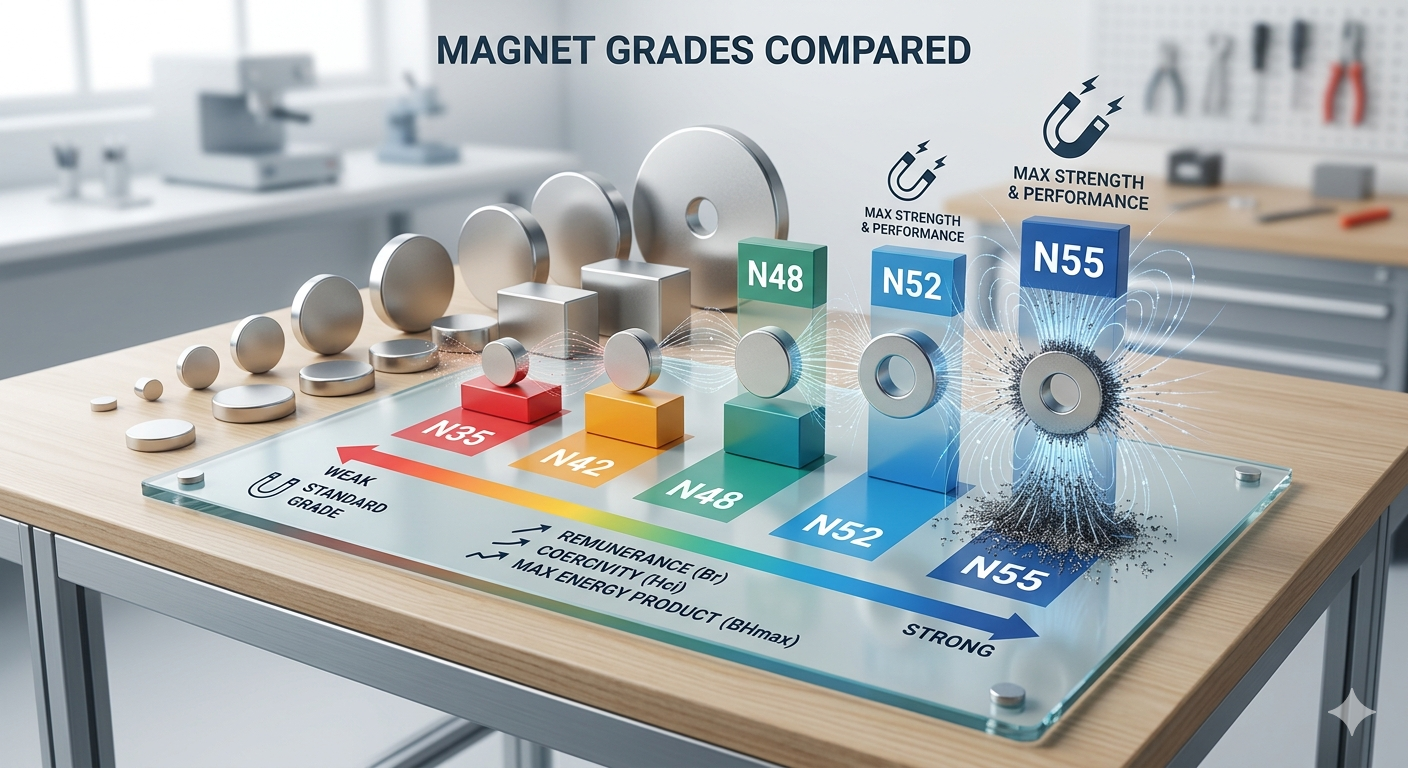
A magnet grade is a shorthand code that encodes three critical magnetic properties: maximum energy product (BHmax), residual flux density (Br), and coercive force (Hc) — all of which determine how powerfully and reliably a magnet will perform in a given environment.
Each magnet type has its own grading system. Neodymium (NdFeB) magnets use an "N" prefix followed by a number (e.g., N35, N52), while samarium cobalt magnets use designations like SmCo18 or SmCo26. Alnico magnets use grades 1 through 9, and ferrite (ceramic) magnets are classified as C1 through C8 or by the Y-series in Chinese standards.
Understanding the numbers and letters in a magnet grade code reveals everything about how the magnet will behave:
- The number in neodymium grades refers to the maximum energy product in Mega-Gauss-Oersteds (MGOe). N52 has a BHmax of approximately 52 MGOe — the highest commercially available grade.
- The letter suffix (M, H, SH, UH, EH, AH) indicates the magnet's maximum operating temperature and intrinsic coercivity rating.
- No suffix (e.g., N35, N42) means standard temperature resistance up to approximately 80°C (176°F).
The Three Core Magnetic Properties Behind Every Magnet Grade
Every magnet grade is defined by three measurable properties that together determine real-world performance: residual flux density (Br), coercive force (Hc), and maximum energy product (BHmax).
1. Residual Flux Density (Br)
Br measures the strength of the magnetic field a magnet produces after the magnetizing field is removed. It is expressed in Tesla (T) or Gauss (G), where 1 Tesla = 10,000 Gauss. A grade N52 neodymium magnet has a Br of approximately 1.44–1.52 T, while an N35 magnet measures around 1.17–1.22 T. Higher Br means a stronger pull force for a given magnet size.
2. Coercive Force (Hc)
Hc is the resistance of a magnet to demagnetization — how hard it is to strip away the magnet's field using an opposing magnetic force or elevated temperature. It is measured in Oersteds (Oe) or kA/m. Higher-grade temperature designations (H, SH, UH, EH) achieve higher coercivity at the cost of slightly reduced Br. For motors and generators where the magnet faces strong opposing fields, coercivity is often more important than raw pull strength.
3. Maximum Energy Product (BHmax)
BHmax is the single most important number in any magnet grade. Expressed in MGOe (Mega-Gauss-Oersteds) or kJ/m³, it represents the density of magnetic energy stored in the material. A higher BHmax means you can use a physically smaller magnet to achieve the same holding or lifting force, which matters enormously in applications where space and weight are constrained — such as electric vehicle motors, aerospace components, and miniaturized electronics.
Neodymium Magnet Grades Explained: From N35 to N52 and Beyond
Neodymium magnets are the strongest permanent magnets available commercially, and their grade system — ranging from N35 to N52 — is the most widely referenced magnet grade classification in engineering and manufacturing today.
The "N" prefix stands for neodymium iron boron (NdFeB). The number following indicates the BHmax value in MGOe. The optional letter suffix denotes the maximum operating temperature and coercivity class:
- No suffix (standard): Max operating temp ~80°C
- M (Medium): Max operating temp ~100°C
- H (High): Max operating temp ~120°C
- SH (Super High): Max operating temp ~150°C
- UH (Ultra High): Max operating temp ~180°C
- EH (Extreme High): Max operating temp ~200°C
- AH (Aerospace High): Max operating temp ~230°C
| Grade | BHmax (MGOe) | Br (T) | Max Temp (Standard) | Typical Application |
| N35 | 33–36 | 1.17–1.22 | 80°C | Craft projects, general use |
| N42 | 40–43 | 1.29–1.35 | 80°C | Sensors, holding fixtures |
| N45 | 43–46 | 1.32–1.38 | 80°C | Speakers, actuators |
| N48 | 46–49 | 1.37–1.43 | 80°C | Motors, medical devices |
| N52 | 50–53 | 1.44–1.52 | 80°C | High-performance motors, MRI |
| N42SH | 40–43 | 1.29–1.35 | 150°C | Automotive, industrial motors |
| N38UH | 36–39 | 1.22–1.28 | 180°C | EV motors, turbines |
Table: Neodymium magnet grades comparison by BHmax, residual flux density, temperature rating, and typical application.
One critical trade-off: as the grade number increases (stronger BHmax), the magnet becomes more brittle and more susceptible to corrosion. N52 magnets are mechanically fragile and require protective coatings (nickel, epoxy, or gold plating) in most applications. N35 magnets are comparatively more durable and easier to handle safely.
Samarium Cobalt Magnet Grades: The High-Temperature Alternative
Samarium cobalt (SmCo) magnets offer magnet grades that withstand temperatures up to 350°C — making them the preferred choice for aerospace, defense, and high-heat industrial applications where neodymium grades would catastrophically fail.
SmCo magnets come in two main series, each with distinct grade characteristics:
SmCo Series 1:5 (SmCo5)
These grades (SmCo14 through SmCo20) have BHmax values ranging from 14 to 20 MGOe. While lower in absolute energy product than neodymium, SmCo5 grades exhibit extremely high coercivity — typically 700–900 kA/m — making them virtually immune to demagnetization. They operate reliably up to 250°C and are used in precision instruments, microwave devices, and traveling wave tubes.
SmCo Series 2:17 (Sm₂Co₁₇)
These grades (SmCo22 through SmCo32) achieve BHmax values of 22–32 MGOe — approaching lower-tier neodymium grades while retaining full temperature resistance up to 350°C. The intrinsic coercivity of Sm₂Co₁₇ grades reaches 1,600 kA/m or higher, the highest of any commercial permanent magnet material. Applications include jet engine sensors, satellite components, and downhole oil drilling tools.
| Grade | BHmax (MGOe) | Max Temp (°C) | Coercivity (kA/m) | Series |
| SmCo16 | 15–17 | 250 | 700–800 | 1:5 |
| SmCo20 | 19–21 | 250 | 800–900 | 1:5 |
| SmCo26 | 25–27 | 350 | 1,200–1,400 | 2:17 |
| SmCo30 | 29–32 | 350 | 1,400–1,600 | 2:17 |
Table: Samarium cobalt magnet grades by energy product, maximum temperature, and coercivity.
Alnico Magnet Grades: The Classic Performer for High-Temperature Stability
Alnico magnet grades (1 through 9) offer the highest operating temperatures of any commercial permanent magnet — up to 540°C — but with significantly lower coercivity than rare-earth grades, making them suitable only for applications with low risk of demagnetization.
Alnico is an alloy of aluminum (Al), nickel (Ni), and cobalt (Co) — hence the name. The grade number reflects the alloy composition and manufacturing method (cast vs. sintered). Cast alnico grades (Alnico 1–9) are isotropic or anisotropic, with BHmax values ranging from 1.4 MGOe (Alnico 1) to 10.5 MGOe (Alnico 9). Sintered alnico grades offer slightly lower magnetic performance but greater dimensional consistency.
Key applications for alnico grades include electric guitar pickups, analog sensors, relays, loudspeakers, and magnetron tubes. Despite low coercivity (typically 50–160 kA/m), alnico magnets maintain their magnetization reliably in stable, non-reversal environments at extreme temperatures where neodymium and SmCo grades would degrade or oxidize.
Ferrite (Ceramic) Magnet Grades: The Cost-Effective Workhorse
Ferrite magnet grades — classified as C1 through C8 in North American standards or Y10 through Y40 in the Chinese/ISO system — deliver moderate magnetic performance at the lowest cost per kilogram of any permanent magnet material, making them the most widely manufactured magnet type in the world.
Ferrite (ceramic) magnets are made from iron oxide combined with strontium or barium carbonate. They are hard, brittle, corrosion-resistant, and inexpensive — a 10 lb bag of ferrite magnet material costs a fraction of equivalent neodymium material. BHmax values for ferrite grades range from 1.0 MGOe (C1) to 4.0 MGOe (C8), which is approximately 10–12 times lower than top-tier neodymium grades.
| Grade (US) | Grade (ISO/China) | BHmax (MGOe) | Br (T) | Best Use Case |
| C1 | Y10 | 1.0–1.2 | 0.20–0.23 | Craft magnets, toy magnets |
| C5 | Y25 | 2.7–3.2 | 0.35–0.39 | DC motors, loudspeakers |
| C8 | Y35 | 3.5–4.0 | 0.41–0.44 | Holding magnets, MRI shielding |
Table: Ferrite (ceramic) magnet grades in US and ISO/China standards with key magnetic properties.
Ferrite magnets are corrosion-resistant without coatings, withstand temperatures up to 250°C, and are the preferred choice for applications where large volume, low cost, and moderate strength are priorities — such as refrigerator door seals, small DC motors in household appliances, and magnetic separation systems.
Magnet Grades by Type: A Head-to-Head Performance Comparison
When comparing magnet grades across different material types, neodymium leads in raw magnetic strength, samarium cobalt leads in temperature resistance, alnico leads in thermal stability, and ferrite leads in cost-efficiency — each grade family has a domain where it is unbeatable.
| Property | Neodymium (NdFeB) | Samarium Cobalt | Alnico | Ferrite |
| BHmax Range (MGOe) | 33–53 | 14–32 | 1.4–10.5 | 1.0–4.0 |
| Max Operating Temp | 80°C–230°C | 250°C–350°C | Up to 540°C | Up to 250°C |
| Coercivity | High–Very High | Very High–Extreme | Very Low | Medium |
| Corrosion Resistance | Poor (needs coating) | Excellent | Good | Excellent |
| Relative Cost | Medium–High | Very High | Medium | Very Low |
| Fragility | High (brittle) | High (brittle) | Low (tough) | Medium (brittle) |
Table: Cross-material comparison of magnet grades by key performance and physical properties.
How to Choose the Right Magnet Grade for Your Application
Selecting the correct magnet grade requires answering four questions: What strength is needed? What temperature will the magnet reach? Will it face opposing magnetic fields? And what is the size and budget constraint?
Step 1: Define the Required Holding or Lifting Force
Start with the force requirement in pounds or Newtons. Higher-grade neodymium magnets can deliver pull forces exceeding 600 lbs from a disc just 3 inches in diameter. A grade N52 2"×1"×½" block magnet, for example, delivers approximately 110 lbs (490 N) of pull force against a steel surface — useful data when selecting a grade for fixture, clamping, or lifting applications.
Step 2: Assess the Operating Temperature
This is the most commonly overlooked factor in magnet grade selection. A standard N42 magnet begins to permanently lose magnetization above 80°C. If your application involves motor heat, engine compartments, or industrial ovens, you must either step up to an N42H, N42SH, or N42UH grade — or switch entirely to samarium cobalt or alnico grades for the highest thermal environments.
Step 3: Evaluate Demagnetization Risk
Applications where the magnet is surrounded by opposing fields — such as in motors, generators, or MRI shielding — require grades with high coercivity. In these scenarios, choosing a grade with an SH or UH suffix over a standard grade can mean the difference between 10 years of stable performance and complete demagnetization within months.
Step 4: Consider Physical and Environmental Constraints
If the magnet will be exposed to moisture, salt water, or chemicals, corrosion resistance becomes a priority. Ferrite and SmCo grades resist corrosion naturally. Neodymium grades require protective coatings; nickel-copper-nickel triple-layer plating is standard, but epoxy or parylene coating is required for marine or high-humidity environments. Consider also mechanical shock — alnico and ferrite grades are less likely to chip or shatter than brittle neodymium or SmCo grades under impact.
Real-World Applications: Which Magnet Grade Is Used Where?
Different industries consistently favor specific magnet grades based on their unique combinations of performance requirements, environmental conditions, and cost sensitivity.
- Electric Vehicles (EV Motors): N38UH to N45SH neodymium grades are standard. These grades balance high BHmax with the 150°C+ operating temperatures inside traction motors. A single EV drive unit may contain 2–4 kg of graded neodymium magnets.
- Wind Turbines: Large direct-drive turbines use N35SH or N38SH grade neodymium magnets in multi-segment rotor arrays. A single 3 MW direct-drive turbine may use 600–700 kg of neodymium magnet material.
- Medical Devices (MRI): High-field MRI systems use superconducting electromagnets, but permanent magnet MRI scanners use N50 or N52 grade neodymium arrays producing fields of 0.2–0.7 Tesla.
- Consumer Electronics: Smartphone speakers, headphones, and vibration motors predominantly use N35–N42 grade neodymium magnets due to their compact size and high force density.
- Aerospace & Defense: SmCo26 and SmCo30 grades dominate in gyroscopes, radar systems, and satellite attitude control, where temperature swings from -180°C to +300°C are routine.
- Guitar Pickups: Alnico 2 (warm, compressed tone), Alnico 5 (bright, clear tone), and Alnico 8 (high-output modern tone) grades are the defining factor in electric guitar pickup sound — a well-understood application of alnico grade differences among musicians and luthiers.
- Refrigerator Seals & DC Motors: Ferrite C5 and C8 grades dominate due to their corrosion resistance, dimensional stability, and extremely low per-unit cost — tens of millions of these are manufactured daily worldwide.
Frequently Asked Questions About Magnet Grades
Q: Is a higher magnet grade number always better?
Not necessarily. A higher number in neodymium grades (e.g., N52 vs. N35) means greater magnetic energy product and stronger pull force — but it also means greater brittleness, slightly reduced temperature stability, and higher cost. For applications that don't require maximum field strength, a mid-grade such as N42 often provides the best balance of performance, durability, and price. Always match the grade to the application's actual requirements rather than defaulting to the highest available.
Q: Can magnets lose their grade over time?
Yes. All permanent magnets experience some degree of demagnetization over time, but the rate depends on grade and conditions. High-grade neodymium magnets stored at room temperature away from opposing fields and heat will lose less than 1% of their magnetization over 100 years. However, exposing any magnet to temperatures above its rated maximum — even briefly — can cause immediate, irreversible partial demagnetization that no re-magnetizing process can fully repair.
Q: What is the difference between N42 and N42H magnet grades?
Both grades have the same BHmax value (~40–43 MGOe) and residual flux density (Br ~1.29–1.35 T). The key difference is maximum operating temperature: N42 is rated to 80°C, while N42H is rated to 120°C. The "H" suffix indicates higher intrinsic coercivity achieved through modified alloy composition or processing — at a cost premium of approximately 10–20% over standard N42.
Q: Are magnet grades standardized globally?
There is broad international alignment on rare-earth magnet grade designations, but not complete standardization. The IEC 60404-8-1 standard and Chinese GB/T standards for NdFeB are widely followed, but some manufacturers use proprietary grade designations that don't map directly. Always request the full demagnetization curve (B-H curve) from the supplier for critical engineering applications rather than relying on the grade number alone to verify exact performance.
Q: What magnet grade should I use for an outdoor or marine application?
For outdoor or marine environments, the best options are ferrite (C5–C8) for moderate-strength needs or samarium cobalt (SmCo26–SmCo30) for high-strength requirements. Both are inherently corrosion-resistant without additional coatings. If neodymium grades are required for strength, specify epoxy or parylene-C coating rather than standard nickel plating, which can delaminate in salt water environments over time. Regularly inspect and replace neodymium magnets in marine service as a preventive measure.
Q: Can I upgrade the grade of a magnet I already have by re-magnetizing it?
Re-magnetizing can restore a partially demagnetized magnet to its original grade specification, but it cannot upgrade a magnet beyond its material's inherent BHmax ceiling. The magnetic grade is determined by the alloy composition and microstructure established during manufacturing — not by the strength of the applied magnetizing field. To achieve a higher grade, you must replace the magnet with one made from a higher-grade material.
Q: How do magnet grades affect pricing?
Within the neodymium family, each grade step upward (e.g., N35 → N42 → N48 → N52) typically adds 5–15% to the per-unit price for the same geometry. Temperature-rated suffixes add further cost: an N42UH can cost 25–40% more than a standard N42 of identical dimensions. Samarium cobalt grades are 3–5× more expensive than equivalent neodymium grades by weight, primarily due to the cost of cobalt and the more complex sintering process.
Conclusion: Matching the Right Magnet Grade to Your Needs
Understanding magnet grades is not just a technical exercise — it is the foundation of reliable, safe, and cost-effective design in any application that depends on permanent magnets.
The key takeaway: no single magnet grade is universally superior. N52 neodymium delivers unmatched raw magnetic energy but fails above 80°C and corrodes rapidly without protection. SmCo30 survives 350°C environments with extraordinary coercivity but costs five times more. Alnico 5 excels in high-temperature stability with unique tonal properties for audio applications but demagnetizes easily under opposing fields. Ferrite C8 is the economical, weather-resistant choice for large-volume, moderate-strength applications.
When selecting a grade, always start with the operating environment — temperature, chemical exposure, and opposing field strength — before optimizing for magnetic force. A correctly graded magnet performs reliably for decades; an under-specified one can fail in weeks. Consult the full B-H demagnetization curve for any magnet grade used in critical engineering, and always verify the grade with certified test data from your supplier rather than relying on nominal specifications alone.